
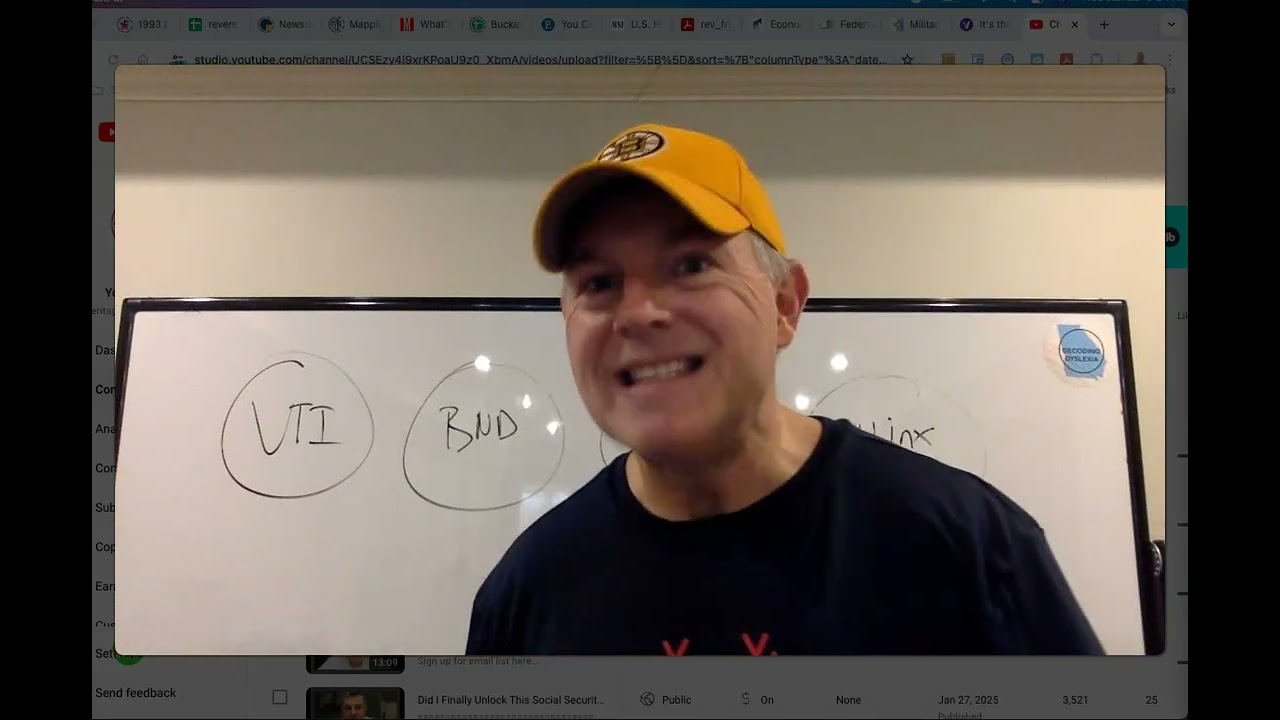

These 4 Vanguard Funds Should Be the Core of Everyone’s Portfolio
When building an investment portfolio, the right foundation is crucial. For many investors, Vanguard funds offer a combination of low costs, diversified options, and historical performance that makes them a sensible choice for a core portfolio. Here, we take a look at four Vanguard funds that can serve as foundational investments for almost anyone, regardless of their risk tolerance or investment goals.
1. Vanguard Total Stock Market Index Fund (VTSAX)
The Vanguard Total Stock Market Index Fund (VTSAX) is a standout choice for investors seeking broad exposure to the U.S. equity market. It includes stocks of all sizes, from large-cap companies to small-cap firms, giving investors a comprehensive representation of the entire U.S. stock market.
Advantages:
- Diversification: With thousands of stocks in its portfolio, VTSAX reduces the risk of relying on individual companies for returns.
- Low Fees: Like many Vanguard funds, VTSAX boasts a low expense ratio, ensuring that more of your money is working for you rather than going toward fund management costs.
- Historical Performance: Over the long-term, the U.S. stock market has historically trended upward, making VTSAX a strong option for capital appreciation.
2. Vanguard Total Bond Market Index Fund (VBTLX)
To balance the risk that comes with equity investments, the Vanguard Total Bond Market Index Fund (VBTLX) is an excellent choice. This fund provides exposure to the entire U.S. bond market, including government bonds, corporate bonds, and mortgage-backed securities.
Advantages:
- Stable Income: Bonds typically offer lower volatility than stocks and can provide consistent interest income, making VBTLX an ideal stabilizer in a portfolio.
- Diversification: By investing in a wide range of bonds, VBTLX reduces the risk that a downturn in any one sector will severely impact your overall investments.
- Low Expense Ratio: As with many Vanguard offerings, VBTLX maintains a low cost structure, which can lead to significant savings over time.
3. Vanguard FTSE All-World ex-US Index Fund (VFWAX)
To gain global diversification, the Vanguard FTSE All-World ex-US Index Fund (VFWAX) is a prime option. This fund allows investors to tap into international equities outside the United States, providing exposure to key emerging and developed markets around the world.
Advantages:
- Global Reach: VFWAX offers a diversified investment across various regions and industries, reducing dependence on the U.S. market’s performance.
- Growth Potential: Emerging markets often have higher growth potential compared to developed markets, and VFWAX gives investors access to this potential.
- Expense Efficiency: Like the other Vanguard funds, VFWAX comes with a low expense ratio, which is vital for maximizing long-term returns.
4. Vanguard S&P 500 ETF (VOO)
Last but not least, the Vanguard S&P 500 ETF (VOO) is another core holding that any investor should consider. This fund tracks the performance of the S&P 500 Index, which is comprised of the 500 largest companies in the U.S. and represents approximately 80% of the U.S. stock market’s total value.
Advantages:
- Market Leader: The S&P 500 includes some of the most well-established and financially robust companies, which tend to provide solid long-term growth.
- Liquidity and Accessibility: As an ETF, VOO can be traded throughout the day, providing investors with flexibility and the ability to react to market movements.
- Low Costs: VOO features a competitive expense ratio, making it a cost-effective way to invest in a diversified array of large-cap stocks.
Conclusion
Vanguard funds provide a robust foundation for any investment portfolio due to their broad diversification, low fees, and historical performance. By including the Vanguard Total Stock Market Index Fund, Total Bond Market Index Fund, FTSE All-World ex-US Index Fund, and S&P 500 ETF, investors can create a well-rounded portfolio that balances risk and return. While individual financial goals and situations may vary, these four funds can serve as reliable cornerstones for long-term investment success. As with any investment strategy, however, it’s essential to do your research and consider consulting with a financial advisor to tailor your portfolio to your specific needs.
LEARN MORE ABOUT: IRA Accounts
INVESTING IN A GOLD IRA: Gold IRA Account
INVESTING IN A SILVER IRA: Silver IRA Account
REVEALED: Best Gold Backed IRA



Am I subscribed to this channel? Note to self remember to unsubcrible, you're too rude. If you're gonna give professional education, then please be professional!
I just switched up my Roth IRA to 50% SCHD, 25% SCHX, 25% SCHG, and my Roth 401k is 70% vanguard S&P 500 index, 20% vanguard growth index, and 10% vanguard international index. Seeking best possible ways to grow $350k into $1m+ before retirement, I'm 55.
Josh,I put these 4 in portfolio visualizer under financial goals and on a 25 year horizon they didn't look too pretty. Just saying.
Thanks Josh. There is nothing better than a regular guy explaining to the masses what seems to be very complex into language that we can all understand. Appreciate your wit and humor and insights that make it easy for us to consume in bite size pieces!
I want to be cool like Josh. 91A keeps 11B going.
Nice job!!!
Josh. Like your diversified portfolio approach. However, aren’t the Wel and Wel funds a problem for asset location?- like stocks in the Roth and fixed income in the pretax.
Also, if you want to keep a certain balance like 60:40, and if you’re taking income from those investments, then you might want to sell stock for income if your stock ratio is high and sell bonds during periods where the stock balance is lower. This helps to rebalance and also to buffer sequence of returns which might make a balanced portfolio perform even better than you showed. Wel and Wel don’t seem to fit in that scheme.?
Bond funds are garbage. All of them. They perform badly in good markets and bad markets. If you are desperate for bond exposure just buy bonds and hold to maturity. The funds provide no real crash protection and are outgained by pretty much every other asset class. People can argue that stocks are manipulated, but the bond market is completely manipulated by the Federal reserve and no one argues it isn't. Historically not a good group to bet your wealth on.
BND is trash. Go with a solid dividend ETF instead like SCHD or VYM.
Vanguard is owned by Black Rock, and changes policies constantly unknown to investors. They will hide tax obligations on the profits till it's time to collect and will adjust to benefit their own profit. Vanguard does what Black Rock tells them to do.
Ugh…..