
[ad_2]
Understanding 10-Year Average TSP Returns: A Comprehensive Guide
The Thrift Savings Plan (TSP) is a retirement savings plan for federal employees and members of the uniformed services. It operates similarly to a 401(k) plan, allowing participants to save and invest for their future. Understanding TSP returns, particularly the 10-year average returns, can help investors make informed decisions about their retirement savings strategy. In this article, we explore the 10-year average TSP returns, its significance, and factors influencing these returns.
What is the TSP?
The Thrift Savings Plan is a defined contribution plan that allows federal employees to invest their savings in various funds. Participants can choose from a range of options, including:
- G Fund (Government Securities Investment Fund): A stable investment choice backed by government securities.
- F Fund (Fixed Income Index Investment Fund): Invests in fixed-income securities, aiming to track the performance of the Bloomberg U.S. Aggregate Bond Index.
- C Fund (Common Stock Index Investment Fund): Invests in large-cap U.S. stocks, intended to mirror the performance of the S&P 500 Index.
- S Fund (Small Capitalization Stock Index Investment Fund): Focuses on stocks of small to medium-sized U.S. companies.
- I Fund (International Stock Index Investment Fund): Invests in international stocks, seeking to replicate the performance of the MSCI EAFE Index.
Each of these funds has different risk profiles and potential returns, allowing participants to tailor their investment strategies based on their risk tolerance and retirement goals.
The Importance of 10-Year Average Returns
The 10-year average return is a critical metric for evaluating the performance of TSP funds. This figure smooths out short-term volatility and provides a clearer picture of long-term investment performance. By considering a decade’s worth of returns, participants can gauge how their investments have performed in various market conditions, which is particularly relevant for retirement planning.
Analyzing the 10-Year Average TSP Returns
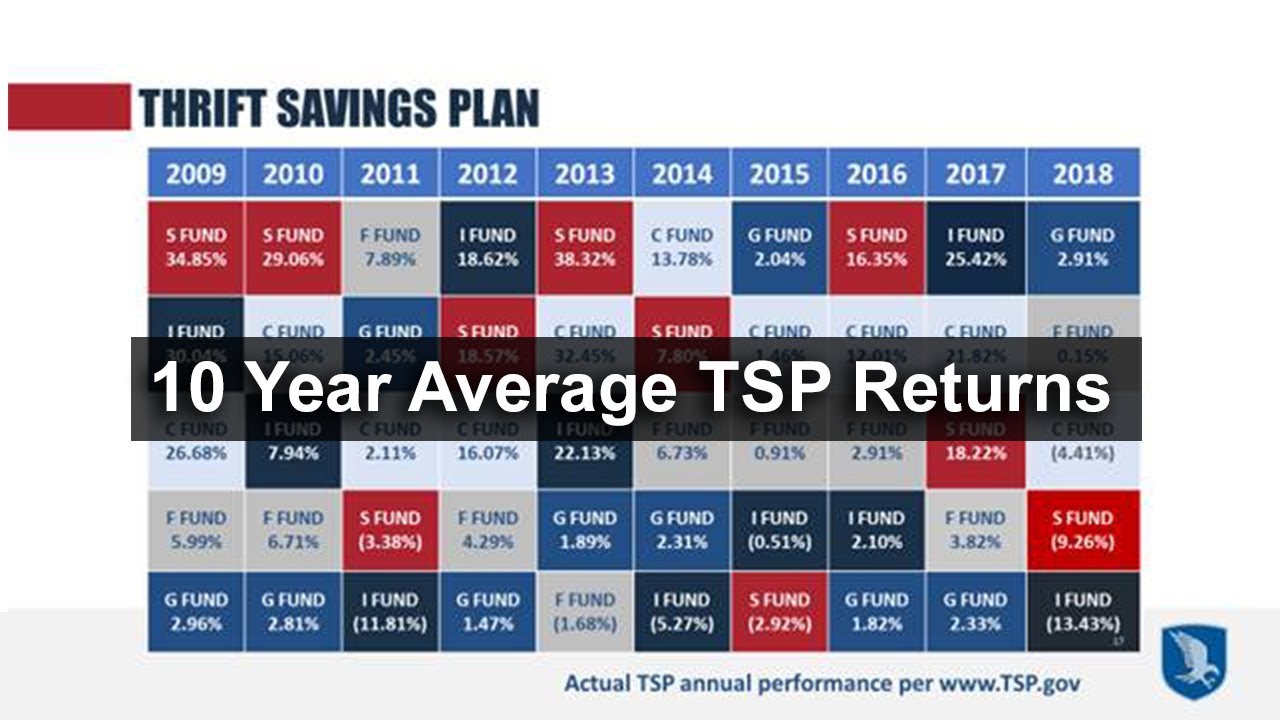
As of the latest data, here’s a general overview of the average annual returns for the TSP funds over the past 10 years (numbers may vary based on market conditions):
- G Fund: Typically offers a stable return, often around 2% to 3%. It is considered the safest option as it is backed by government securities.
- F Fund: Generally reflects annual returns between 3% and 5%, depending on interest rates and bond market conditions.
- C Fund: Historically, the C Fund has provided average returns of around 10% per year, aligning with long-term stock market performance.
- S Fund: This fund’s returns can vary significantly, often yielding between 8% to 11% on average, reflecting the performance of smaller companies.
- I Fund: Average returns for the I Fund have hovered around 5% to 8%, influenced by international economic conditions.
These averages illustrate a spectrum of risk and return, giving TSP participants insights into the trade-offs associated with different investment choices.
Factors Influencing TSP Returns
Several factors can impact the 10-year average TSP returns, including:
-
Market Conditions: Economic cycles play a significant role in stock and bond performance. Bull markets tend to boost equity fund returns, while bear markets can diminish them.
-
Interest Rates: Bond fund returns are often inversely related to interest rates. Rising rates can lead to lower bond prices, affecting the F Fund’s performance.
-
Inflation: Inflation can erode purchasing power, impacting real returns on investments. TSP participants should consider the relationship between nominal returns and inflation.
-
Investment Strategy: Individual investment choices and diversification strategies can heavily influence overall returns. A balanced portfolio can mitigate risks while maximizing potential gains.
- Global Events: Geopolitical issues, global economic shifts, and environmental factors can all sway stock markets and, consequently, TSP fund returns.
Conclusion
Understanding the 10-year average TSP returns is pivotal for federal employees and members of the uniformed services. This metric not only provides a historical context for investment performance but also assists in shaping future investment strategies. By leveraging the TSP’s various funds and being mindful of the influencing factors, participants can make educated decisions to build a robust retirement portfolio. As always, consulting with a financial advisor can help tailor investment strategies to individual needs and goals, paving the way for a secure financial future.
LEARN MORE ABOUT: Thrift Savings Plans
REVEALED: Best Investment During Inflation
HOW TO INVEST IN GOLD: Gold IRA Investing
HOW TO INVEST IN SILVER: Silver IRA Investing


0 Comments