

Inflation and the Rule of 72: How Quickly Your Money Loses Value
Inflation, the silent thief of purchasing power, is a constant economic force that erodes the value of our money over time. While a little inflation is generally considered healthy for an economy, runaway inflation can be devastating. Understanding how inflation affects your wealth and how to estimate its impact is crucial for financial planning. This is where the “Rule of 72” comes in handy.
Understanding Inflation
Inflation essentially means that goods and services become more expensive. A loaf of bread that cost $2 five years ago might cost $2.50 today. This means that your dollar buys less than it used to. Several factors can contribute to inflation, including increased demand, rising production costs, and government policies.
The inflation rate is typically expressed as a percentage and represents the annual increase in the general price level. For example, an inflation rate of 5% means that, on average, prices have increased by 5% over the past year.
The Rule of 72: A Quick and Dirty Calculation
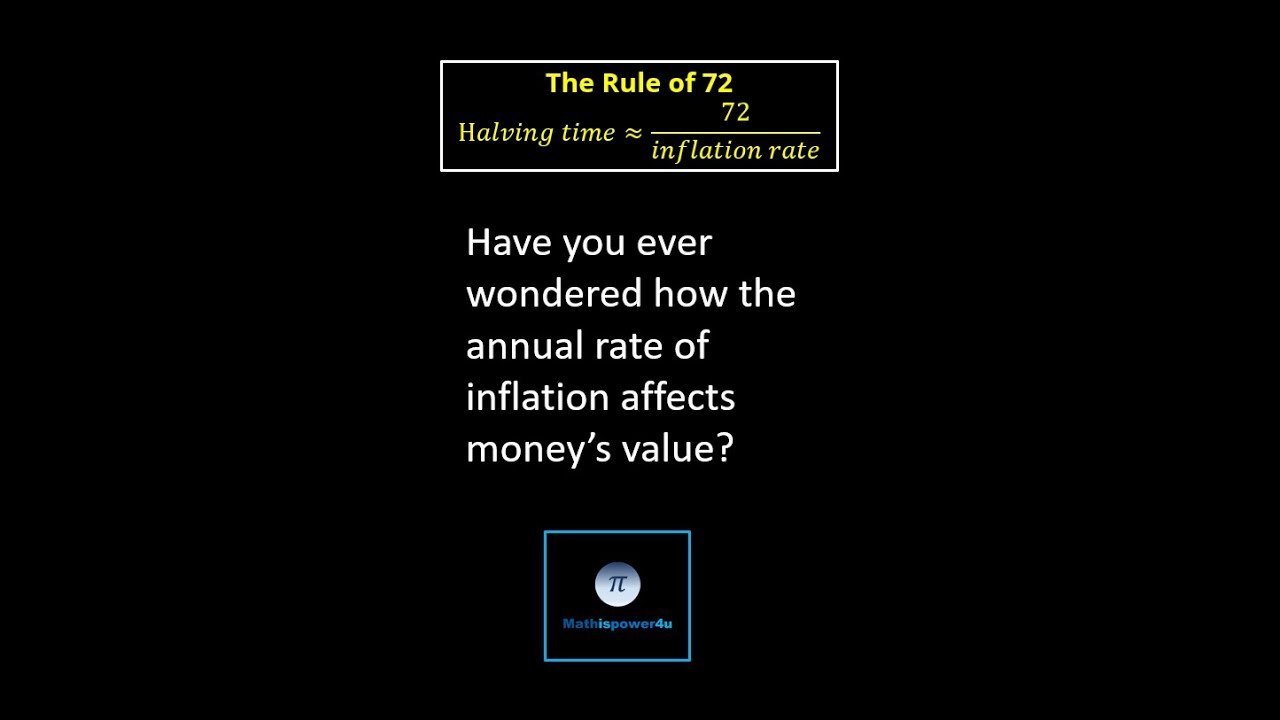
The Rule of 72 is a simple and surprisingly accurate formula used to estimate the number of years it takes for an investment to double, given a fixed annual rate of return. It can also be applied to inflation to estimate how long it takes for the value of your money to be cut in half.
The formula is:
Years to Double (or Halve) = 72 / Interest Rate (or Inflation Rate)
Applying the Rule to Inflation
To determine how long it takes for your money to lose half its value due to inflation, simply divide 72 by the inflation rate. Let’s look at a few examples:
- Inflation Rate of 2%: 72 / 2 = 36 years. At a 2% inflation rate, your money will lose half its value in approximately 36 years.
- Inflation Rate of 4%: 72 / 4 = 18 years. At a 4% inflation rate, your money will lose half its value in approximately 18 years.
- Inflation Rate of 7%: 72 / 7 = 10.3 years (approximately). At a 7% inflation rate, your money will lose half its value in just over 10 years.
Why is this Important?
Understanding the impact of inflation is critical for:
- retirement planning: You need to account for inflation when estimating how much money you’ll need to retire comfortably. A sum that seems adequate today may be insufficient in the future due to rising costs.
- Investment Decisions: Inflation can erode the returns on your investments. You need to consider inflation-adjusted returns to accurately assess the profitability of your investments.
- Savings Accounts: Simply keeping your money in a low-interest savings account may not be enough to outpace inflation. In fact, you could be losing purchasing power.
- Negotiating Salaries: Understanding inflation helps you negotiate salaries and raises that keep pace with the rising cost of living.
Beyond the Rule of 72: More Sophisticated Tools
While the Rule of 72 is a useful estimation tool, it’s important to remember that it’s an approximation. More sophisticated financial planning tools and calculators can provide more accurate projections by factoring in variable inflation rates, compounding interest, and other relevant factors.
Strategies to Combat Inflation
While you can’t control inflation, you can take steps to mitigate its impact:
- Invest in Assets That Outpace Inflation: Consider investing in assets like stocks, real estate, and commodities that historically have outpaced inflation over the long term.
- Consider Inflation-Protected Securities (TIPS): These bonds are designed to protect investors from inflation.
- Diversify Your Investments: Spreading your investments across different asset classes can help to reduce risk and potentially increase returns.
- Re-evaluate Your Budget: Regularly review your budget and adjust your spending to account for rising prices.
Conclusion
Inflation is a persistent economic reality that can significantly impact your financial well-being. The Rule of 72 provides a quick and easy way to estimate how quickly inflation can erode the value of your money. By understanding the impact of inflation and taking proactive steps to mitigate its effects, you can protect your purchasing power and achieve your long-term financial goals. Remember to consult with a qualified financial advisor for personalized advice tailored to your specific circumstances.
LEARN MORE ABOUT: Investing During Inflation
REVEALED: Best Investment During Inflation
HOW TO INVEST IN GOLD: Gold IRA Investing
HOW TO INVEST IN SILVER: Silver IRA Investing




So the value would go down??? It’s supposed to double, so it would be worth 2 times it’s current value not half of it over the years.
If it's 8% per month, then it's actually 9 months.