
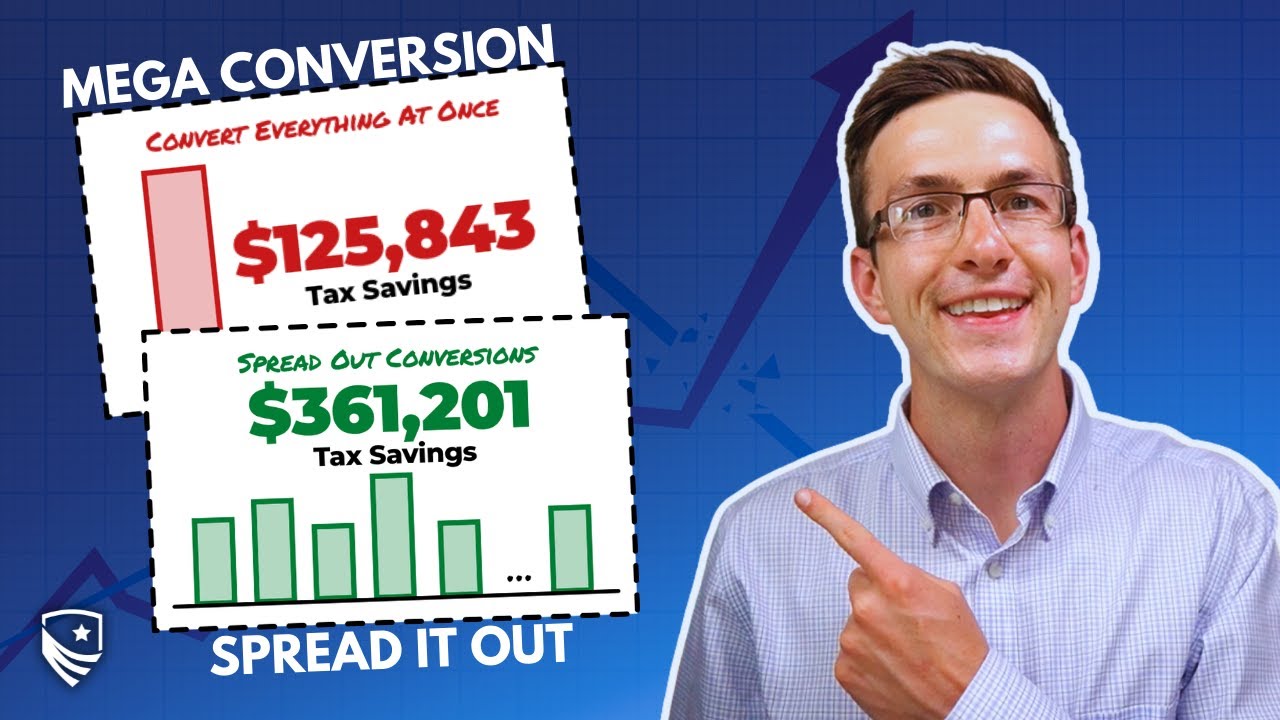

Does a MEGA Roth Conversion Make Sense? Roth Conversion Optimization Explained
In recent years, the term "MEGA Roth conversion" has gained popularity among financial planners and savvy investors looking to optimize their tax strategies for retirement. With the evolving landscape of retirement planning, particularly the IRS regulations surrounding Roth accounts, many individuals are considering whether a MEGA Roth conversion makes sense for their financial future. This article explores the concept of MEGA Roth conversions, their potential benefits, and important considerations to help you determine if this strategy may be right for you.
What is a MEGA Roth Conversion?
A MEGA Roth conversion refers to the process of converting a significant amount of money from a traditional retirement account—like a 401(k) or traditional IRA—into a Roth IRA. This strategy has garnered attention because it allows individuals to leverage the benefits of a Roth IRA, such as tax-free growth and tax-free withdrawals in retirement, especially for those whose income or account balance might disqualify them from contributing directly to a Roth IRA.
The primary allure of a MEGA Roth conversion is the potential to pay taxes now at a lower rate, rather than in retirement when tax rates might increase or when you might find yourself in a higher tax bracket. Essentially, this strategy is about paying your taxes upfront on a larger sum while leveraging the tax-free growth potential of a Roth IRA over time.
Benefits of a MEGA Roth Conversion
1. Tax-Free Growth and Withdrawals
Once your funds are in a Roth IRA, they grow tax-free, and you won’t pay taxes on qualified withdrawals during retirement. This can lead to significant savings over time, especially if your investments perform well.
2. Avoiding Required Minimum Distributions (RMDs)
Traditional retirement accounts are subject to RMDs starting at age 73 (as of 2023), while Roth IRAs are not subject to these requirements. This allows for greater flexibility in managing your retirement income and potentially extends the tax-free growth period.
3. Strategic Tax Planning
By converting to a Roth IRA now, you can choose to manage your tax bracket strategically. If you foresee higher tax rates in the future, or if your income might increase significantly, a MEGA Roth conversion could result in tax savings by locking in your current rate.
4. Estate Planning Benefits
Roth IRAs can be a powerful tool for estate planning. Heirs who inherit Roth IRAs will enjoy tax-free growth and do not need to pay income taxes on withdrawals, making it a generational advantage.
Considerations Before a MEGA Roth Conversion
1. Tax Bill Impact
A MEGA Roth conversion can result in a substantial tax bill in the year of the conversion, as you’ll need to pay income tax on the converted amount. Calculating the exact tax implications is crucial, and it may be wise to consult a tax professional for personalized advice.
2. Timing of Conversion
The timing of the conversion can significantly impact its effectiveness. It might make sense to convert during a year when you expect a lower income (for instance, if you are in between jobs or nearing retirement).
3. Long-Term Outlook
Because converting a significant amount means paying taxes upfront, the decision should consider how long you plan to hold the investments and your expectations for growth. If you plan to use the funds in the short term, a Roth conversion may not be advantageous due to immediate tax implications.
4. Investment Horizon and Rate of Return
A MEGA Roth conversion is most beneficial for individuals who have a long investment horizon, allowing plenty of time for tax-free growth. Individuals who are nearing retirement may find that the tax payment outweighs the benefits.
Conclusion: Does a MEGA Roth Conversion Make Sense?
Whether or not a MEGA Roth conversion makes sense for you will depend on your unique financial situation, retirement goals, and tax circumstances. For those with substantial retirement accounts, a MEGA Roth conversion can serve as a proactive method for tax optimization. However, due diligence, forward planning, and, ideally, consultation with a financial professional will ensure that you navigate this complex territory effectively.
As with any financial strategy, it’s essential to weigh the pros and cons carefully and consider how a MEGA Roth conversion aligns with your broader retirement strategy, ensuring a financially secure and tax-efficient future.
LEARN MORE ABOUT: IRA Accounts
TRANSFER IRA TO GOLD: Gold IRA Account
TRANSFER IRA TO SILVER: Silver IRA Account
REVEALED: Best Gold Backed IRA




I have a question about Mega Roth Conversion. What if couple doesn't need any of the 401K withdraws to live on and all the money would be moved to a brokerage account causing the resulting dividends to be taxed. Shouldn't the tax on these dividends be factored into a Mega Roth Conversion. Also, what about the financial stability of their children and the expected life expectations of the couple?
For me, it's best to do the conversion before the TCJA sunsets in 2025. Thanks for the video!!
wouldn't just moving to a state that doesn't have income tax after you retire be a simpler and easier solution to paying taxes on your 401k money now. to me these Roth conversions seem like just a way for useless financial advisors to make money off of suckers.
I’m 52 and switched to investing all of my 401k dollars to Roth going forward. Wish employee contributions were Roth as well. I’m going to have to start converting the rest in the next couple years. Wanted to wait until I’m in a lower bracket but nervous what taxes will be when I’m 60.
when converting from 401k/IRA to Roth IRA, causing IRMAA premium to increase to next level only impact for the year IRMAA cost goes up ? Doesn't IRMAA premiums look at the income year and adjust accordingly down or up ? In other words IRMAA surcharge each year looks back at your income from 2 years ago (2024 IRMAA looks at income from 2022, 2025 IRMAA look at income from 2023 and so on…) If conversions are occurring each year then IRMAA is impacted accordingly and will eventually cease once all conversions are completed with a prior 2 year lookback. Correct ?
Title can be misleading as people could be confusing this Mega backdoor Roth
I really love your IRMAA Tax Surcharges analysis. However there is a very holistic simple decision helper for most of people considering to do Rollover to Roth Conversions or MEGA Conversions. If they have a family history of chronic desease such as expensive Hearts Desease, Diabetes and so on with Unaffordable Costly "maintenance for the rest of your life Medications" they should try to keep in mind unavoidable anticipated in the very near future in retirement need to either have enough money saved for more expensive IRMAA surcharges and out of pocket extra payments for most of UNCOVERED BY MEDICAID basic Vitamins, any considered OTC Medications, and expensive Unaffordable not part of MEDICARE Formulary or Supplemental MEDICARE Insurance Formulary medications (typically nothing preventive or diagnostcs is covered for example for Diabetics, Dental Health, Eye Health, Hearing Health)… So they might be better off consulting with MEDICARE Insurance Special Agents about different Plans and Eligibility Criteria especially if their older relatives have any chronic desease or died before age 65 for women and 57 for men… Only then it would be much easier to decide to Convert Rollover to Roth or not and how fast and how many years of projected life one might estimate they have before finishing their Conversions (as simple Mathematics are suddenly not so simple and much more complex especially when Taxes are only one of many factors to consider together with possibly buying a Long Term Care Insurance and other future Health and Dental Insurance related things and so many expenses designed to be uncovered deliberately by MEDICARE Insurance that only wealthy and well prepared in advance people could have anticipated years in advance while in relatively better health and at a younger age…
I think the methodology you're using to attach a percentage to the IRMAA value is flawed. The value calculated does reflect the marginal increase of this zone COMPARED TO THE PREVIOUS ZONE, but that number is really not of interest.
To see this, imagine that, instead of a $122 increase in the zone used in the example, there was only a $.01 increase. Using your formula, this would generate a numerator of $.24. Dividing this by $56,000 yields a value close to 0. But, in fact, if one resided in this zone, the actual tax rate associated with doing so is not 0%. Instead, the actual tax rate associated with this zone is a bit lower than that associated with the previous zone, that's all, since one is now required to pay essentially the same premium as in the previous zone, for an extra $50K – $60K of coverage.
What should be calculated instead, for each zone, is the total premium required for that zone, divided by the MAGI dollar amount at the top of that zone. For example for the zone being used (the 3rd zone from 2022), the Part B cost, including IRMAA, is $340.20, and the Part D cost is $32.10. So the total premium for this zone is $340.20 + $32.10 = $372.30. Multiplying that by 12 and by 2 as shown in your example, one has $372.30 x 12 x 2 = $8,935.20. That number should be divided by the top MAGI dollar amount for the zone, which is $284,000 (which assumes the taxpayer can fully populate the zone to this amount). The resultant tax percentage is 3.15%. That is a value which it is reasonable to add to the base tax rate of 24% shown in your example, to arrive at an overall rate of 27.15%.
What guarantees the government won't tax Roth gains in the future? I'm doing conversions and limiting the tax rate to 24% but if they come after Roth gains in the future that would be brutal.
Good video. we have one last rung of seven Roth conversions to complete next yr then retire with the "rule of 55". We will live off 401k's until they are depleted by 61. Tax SS at ~65 and no taxes until about 72 …at lest thats what the software shows. Being "poor on paper" so in lowest bracket for IRMAA. We are huge believers in conversions over time and not in a lump sum!
Why don’t these projections EVER show paying the taxes due with cash outside the IRA? Is it because it will yield a much more convincing result to do ROTH conversions up to the 24% if IIRMA is not a factor? Would love to see this ! Great channel!
Thank you so much for your video! Great information in easy to understand fashion. I have been watching your videos as I am preparing for retirement at 62, in two years. So glad your videos showed up in my feed a few months ago!
I was told that each Roth conversion has its own 5-year clock. That means I have to keep track of each conversion as to when I can withdraw tax free and penalty free. Can you confirm that?
I like how you factor IRMAA premium as a tax rate % when considering Roth conversions. My question for you is whether there would be an advantage to convert more during your first year On Medicare if your bday falls in middle of year or later? Let’s say you turn 65 in September. If you do additional Roth conversions and are hit with higher IRMAA premium, you would only pay that higher premium for 4 months before it resets in January of following year, right?
The married brackets make spreading out conversions look artificially good because they give huge headroom. Single brackets are so much more compressed.
Thanks guys!! Mostly more of the same for me last week. Bought HD, CMCSA, PFFV, PDO, MAIN, VFC, JEPI, NNN and MDT with a $99 limit order.
If you want big subscribers and viewers, make your tube play with a smaller $$ amount. Your numbers simply out of reach for the vast majority.
TCJA are just 4 years to expiration 2026. Married filing jointly bracket 24% will become 33% in the last 100,000 of the 24% tax bracket. Planning on ripping bandaid off in mega Roth conversions in the next 4 years.
I feel the need to over convert in Roth conversions. If one us becomes widowed we move to single tax bracket. Then you need to be concerned about the secure act (for inheritance) which would make your children have RMDs in a 10 year span during there likely high earning tax bracket. I think of it as life insurance from taxes on future growth of investments.
Eric – Thank you for your informative and educational posts. I am a recent retiree age 60 with a sizable ($3M+) 401K balance and I am just now starting to think about Roth conversions. I would like to start to model various scenarios for my situation, do you happen to make any of your tax planning graphs/worksheets from this (2:11) and several of your other videos available for download? Thanks again for the great content.
Please explain why the tax rate paid is more important than the total amount paid in taxes. It seems like many years of tax-free growth will eventually cross a break-even point resulting in a profit.
Thank you for including single people in your examples. I'm 61 and plan on retiring sometime in the next 4 years and will start doing my ROTH conversions then. I'll have lower income and I should be done by the time I'm 72.
I really love your content. Thank you for clear, concise presentation without the clown show.
But for people with high amounts of deferred accounts and 3 years to reach RMD and SS as the only income, will big chunk of conversions make sense?
Good job Eric.
Thank you very informative!
Hedge your risk of tax rates going up by carefully considering Roth decisions.Thanks for another great video Erik.
Do you assume that that tax code (current number of brackets) will stay the same over those 10 yrs of Roth conversions? What if the tax rates go up over time and the number of brackets increase?