
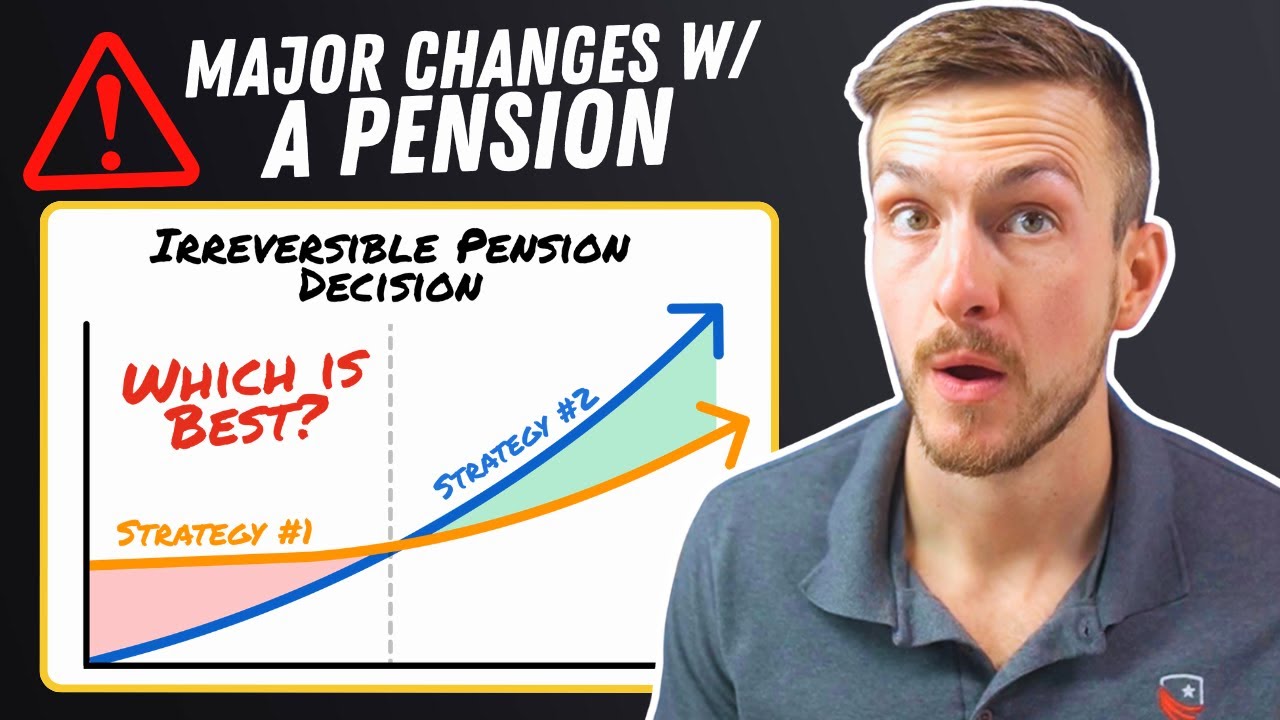

Three Major Retirement Changes Triggered by a Pension (+ Common Mistakes)
For decades, the promise of a comfortable retirement rested on the stability of a pension plan. While defined contribution plans like 401(k)s are now more prevalent, many still receive, or will receive, a pension. Understanding how a pension impacts your overall retirement strategy is crucial for a secure and fulfilling future. A pension introduces unique dynamics to your planning, and failing to account for these can lead to costly mistakes. Here are three major retirement changes triggered by a pension, along with common pitfalls to avoid:
1. Shifted Investment Strategy: Less Aggressive, More Secure
-
The Change: With a pension guaranteeing a stream of income, your reliance on investment returns to cover expenses is reduced. This allows you to adjust your investment portfolio towards a more conservative approach. Instead of chasing high-growth stocks, you can focus on lower-risk investments like bonds and dividend-paying equities. This stability is particularly valuable as you approach retirement, mitigating the risk of a market downturn significantly impacting your lifestyle.
-
Common Mistake: Ignoring Risk Tolerance & Staying Too Aggressive: Many retirees cling to aggressive investment strategies even with a pension in place, hoping to maximize gains. However, this unnecessary risk can lead to significant losses, especially if you need to access your investments earlier than planned. Re-evaluate your risk tolerance and adjust your portfolio accordingly. A financial advisor can help you determine the optimal asset allocation that balances growth with security.
2. Refined Withdrawal Strategy: Tailored to Income Sources
-
The Change: A pension adds a predictable income stream to your retirement budget. This necessitates a refined withdrawal strategy for your other retirement accounts. Instead of blindly following the 4% rule, you can now calculate your annual expenses, subtract your pension income, and determine how much you need to withdraw from your 401(k), IRA, or other investment accounts to cover the remaining shortfall. This allows for a more precise and sustainable withdrawal plan.
-
Common Mistake: Over-Reliance on Pension & Premature Withdrawal: A common misconception is that a pension alone will cover all expenses. Many retirees underestimate their cost of living and prematurely withdraw from their retirement accounts. Before retiring, create a detailed budget that accounts for all potential expenses, including healthcare, taxes, and leisure activities. Calculate the difference between your pension income and your expenses to determine how much you need to withdraw from other sources. Remember to factor in inflation!
3. Enhanced Estate Planning: Considering Pension Survivor Benefits
-
The Change: Pensions often offer survivor benefits, allowing a spouse or other beneficiary to continue receiving a portion of the pension income after your death. This adds another layer of complexity to estate planning. You need to consider how survivor benefits interact with your overall estate plan, ensuring your assets are distributed according to your wishes and minimizing potential tax liabilities.
-
Common Mistake: Neglecting Survivor Benefits & Failing to Update Beneficiaries: Many retirees neglect to thoroughly understand the terms of their pension’s survivor benefits. They may not realize that opting for a higher monthly pension payment now comes at the cost of reduced survivor benefits for their spouse later. Furthermore, failing to update beneficiaries on your pension and other accounts can lead to significant legal and financial complications for your loved ones after your passing.
Conclusion:
A pension provides a significant advantage in retirement planning, offering a guaranteed income stream that can provide peace of mind and financial security. However, maximizing the benefits of a pension requires a proactive and well-informed approach. By understanding how a pension impacts your investment strategy, withdrawal strategy, and estate planning, and avoiding common mistakes, you can craft a retirement plan that aligns with your goals and ensures a comfortable and fulfilling future. It’s always wise to consult with a qualified financial advisor who can provide personalized guidance based on your specific circumstances. Don’t let these potential pitfalls derail your retirement dreams – plan strategically and reap the rewards of a well-managed pension.
LEARN MORE ABOUT: Qualified Retirement Plans
REVEALED: How To Invest During Inflation
HOW TO INVEST IN GOLD: Gold IRA Investing
HOW TO INVEST IN SILVER: Silver IRA Investing



I think it's important to stick to stocks that are immune to economic policies. AI stocks that have the potential to power and transform future technologies. It seems AI is the trajectory most companies are taking, including even established FAANG companies. Maybe there are other recommendations?
Don't forget to mention that forced distribution can be tax-exempt when given to a Qualified Charitable Distribution (QCD)! I'm planning on giving 100% of the money I leave in my Traditional IRA to my church so it's NEVER taxed.
Great video. But it’s a shame all the games our government makes us play trying to trick us rather then just having a flat rate with no deductions that treats everyone the same.
I thought this was an interesting discussion. The problem as it relates to my pension (when I eventually take it, which will be in 10-12 years) is that the monthly benefit amount IS adjusted for inflation every year. So the monthly amount will keep going up over time. Which I think would change the comparisons that you were making?
In my case, the decision between a lump sum or monthly payments basically came down to wanting the diversification safety of having both.
I'd already saved up sizeable amounts both in my 401K and a separate brokerage account, so investable assets in the market was already covered pretty well, but I had no other source of steady reliable income that was safe from market volatility. (Retiring early meant that social security would be at least a decade away.)
So steady, reliable income was the otherwise missing part of my retirement finances which I wanted my pension to cover. That pretty much narrowed down my decision to either monthly payments from the pension itself or a lump sum immediately put into an annuity that would give me similar monthly payments. I looked into some annuities to see what the lump sum amount would get me elsewhere and didn't find any that were better than the pension's own terms for monthly payments, so stuck with the pension. So far I'm happy with the decision.
I am beginning to think I might be screwing up by over-saving looking at that tax impact chart.
I have pension that pays about 65% of my income at 58 or 100% at 64 (each year increasing). I will also have with my wife and I about 4k/m SS. Lastly I have been saving in a 457b about 10% of my income for the last 25 years.
My goal has always been to have more in retirement than working, but my fear is that I’m sacrificing my current enjoyment of my salary only to have those savings I put away for that purpose evaporate to higher taxes.
The discussion at the 15 minute mark was a great description of the reason I do not need a traditional IRA in retirement. Thanks.
Japanese stock market about same level as when it peaked in 1989. It's been helluva good run though I'm the US leading up to this peak. The next 35 years are no guarantee of past returns though.
I took my lump sum and did a ten pay Whole life retirement plan with a long term care rider. My wife and kids are covered for my healthcare and when I pass that extra death benefit money is tax free for them. I can also take withdrawals while alive and it gives me tax flexibility as you pointed out for tax planning. My return is between 3-4%. I have a sizable pretax 401k. So that is why I went to this plan. Great video as always. Very informative.
Pensions from companies that can go bankrupt. I’ll take my risk, put it in a bond and then leave the principal for my kids
Truly you need a lot of cash. My first week of retirement, my 1 1 yo roof needed replacement at 30K. Collateral damage from equipment to lawn—another 1500. Water heater blew 3 months later. Adult child has brain bleed, now I need to move 500 miles and pull a chunk from savings when market is tanking. Spent 4 months in hotels at surgery. Get house prepped for sale. We are burning bills and I’m only 6 months in.
Isn’t the first question to ask what else do you have for retirement? If social security and pension is all you are going to live off of safety of the pension probably the best option. But, if one invested into retirement accounts 401k/403b, ira/roth iras and the pension and ss makes up like 25 percent of retirement income, that the lump sum. However the pension didn’t offer a cost of living increase. 2400 needs to 3500 in 13 years to keep up with a 3 percent inflation. Another reason someone would want more growth.
Isn’t the first question to ask what else do you have for retirement? If social security and pension is all you are going to live off of safety of the pension probably the best option. But, if one invested into retirement accounts 401k/403b, ira/roth iras and the pension and ss makes up like 25 percent of retirement income, that the lump sum. However the pension didn’t offer a cost of living increase. 2400 needs to 3500 in 13 years to keep up with a 3 percent inflation. Another reason someone would want more growth.
An increasing number of people are likely to face challenges in retirement. Low wages, rising inflation, and high rental costs make it difficult to save adequately. Now, even middle-class Americans are struggling to afford homeownership, putting their retirement plans at risk.
I’m lucky enough to have a pension. As a young man I always told myself I’d take the lump sum and invest it. However, after 35 years in the market with my 403b and experiencing the volatility that the market brings. I decided the stability a monthly income was more appealing than the lump sum. I ran the numbers. Retiring at 65, it would take me 11.8 years or 76.8 to reach my lump sum amount. That seemed doable considering my current health. Moreover the monthly pension gives me an annual 8.4% return year over year. Monthly pension and SS gives me the ability to be more aggressive with my IRA, if I so choose, because of the additional monthly source of income. It’s a decision I’ve never regretted.
The problems with your scenario are that, at least in comparison to my own pension,
1) the monthly payout is more than your example even with 100% survivorship option for my wife and
2) the lump sum they offered me at age 60 was lower than in your example.
Plus, by taking my pension at age 60, they added a social security gap benefit, equal to my social security at age 62, plus they allowed me to continue on their group health insurance until age 65, which is a huge benefit over COBRA insurance rates.
I buy 200 dollars worth of scratch offs at the gas station every Friday morning.
Spot on
Nice video, and relatable to me for sure. Both I and my wife have pensions. We are hopefully 3-5 years away from Retirement. As of now, I'm definitely doing the Lump Sum rolling into our respective IRA's. The reasons for this are many, and some of them were not covered in the video. 1. For a non-government pension you run a non-zero chance that the company you worked for, and their pension, could go bankrupt or reduce allocations. Our pension has no COLA, so the lump sum locks us in. 2. No one knows how long you will live. There are great tables for figuring out the AVERAGE lifespan, but things happen. Terminal illness, accidents, etc. 3. Figuring out what kind of return you can get investing your own lump sum is quite variable, however, for myself and my specific situation, I will have our asset allocation in a 70/30 configuration. Average returns since 2000 for this type of portfolio are 7.65%/yr. I'm comfortable with volatility, because I will be using the mental concept of the Bucket system, with fixed assets able to fund 5 years of expenses. So yeah….Lump Sum for the Win Alex!
Dude you are so good. Huge brain. A million different scenarios that you seem to cover flawlessly.
One huge factor is the whether or not the pension can seize to exist, especially for smaller companies if they go bankrupt. Yes many are insured by PBGC but some are not who knows about future status of PBGC as well
My main worry with a pension is inflation. I just feel like i have more control going with the lump sum. OTOH, some of the benefits of the pension are still tempting.
I’m used to paychecks so the monthly pension and SS checks will feel more comfortable.
Great video. I took the lump sum and rolled it into an IRA and bought a 20 year T bond with half with a YTM of 5.02%. I then took the equivalent of the other half in my brokerage account and bought long term municipal bonds with a tax free YTM of 4.6%. All are rated A+ to AAA. My after tax income is about $5k per year less than the annuity which means the annuity will never catch up and if I die prematurely my heirs get the lump sum.
That point about a pension effectively acting as an RMD regarding taxes makes sense to me.
I've been planning to use planning software to help decide on Roth conversions, but this context will help me make sense of why it may recommend we convert it all.
Excellent review of pension vs lump sum. I went through this about 18 months ago. I chose the pension for two primary reasons. First, my wife’s family longevity is off the charts, so I took the 75% survivor option. Second, interest rates had jumped up at that time, which really reduced the lump sum offer as compared to a few years earlier. I didn’t like the idea of buying an annuity inside an IRA (where my lump sum would be), and that option looked pretty bad compared to the monthly pension. Something I didn’t have at the time was claude ai. It’s a great tool for calculating present value, and running what if scenarios. Also, I appreciate your thoughts on including the pension in asset allocation. I haven't given that enough thought.
With all other things being equal, there is no situation where a pension is "bad."
You don't want to make it too complicated. But generally, retirees with a substantial amount of guaranteed income are the happiest retirees.
I so appreciate this video for singles. Biggest concern aside from saving enough is the tax hit a single takes with a modest pension, social security and traditional IRA withdrawals, especially at RMD. Having this awareness prior to retirement is a good thing. I'm hoping to delay SS (bigger payment and in case eligible age or payout amount gets reduced) but would have to live extremely lean if retiring before SS, and find a way to pay for the Roth conversions.
Barry, take the pension. It’s guaranteed monthly income no matter what the market does and no matter how long you live. If you die before your “break even” point, you won’t care because you’ll be dead.