
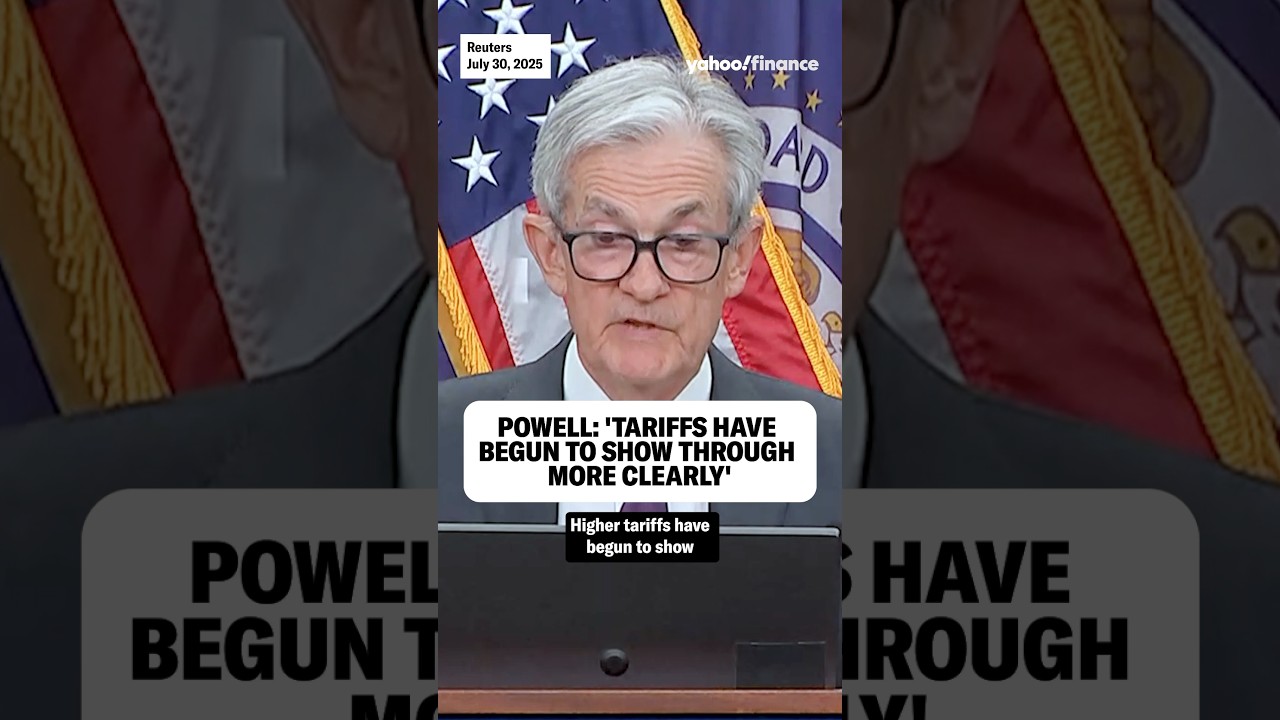

Powell Signals Growing Concern: “Higher Tariffs Have Begun to Show Through More Clearly”
Jerome Powell, Chairman of the Federal Reserve, has consistently maintained a cautious stance on the US economy, navigating the delicate balance between promoting growth and managing inflation. Recent comments, however, suggest a shift in tone, with Powell acknowledging the increasingly evident impact of higher tariffs on the American economy. He noted that “higher tariffs have begun to show through more clearly,” signaling a potential change in the Fed’s perspective and a willingness to consider their economic consequences more directly.
For months, the Fed has downplayed the direct impact of trade tensions, focusing instead on overall economic indicators like employment and GDP growth. While acknowledging the uncertainty tariffs created for businesses, they largely attributed any slowdowns to factors like global economic weakness and slowing investment. However, Powell’s recent statement suggests that the effects of these tariffs, initially dismissed as negligible, are now becoming too significant to ignore.
What specifically are these “clearer” impacts? Experts point to several key areas where tariffs are demonstrably influencing the economy:
- Increased Inflation: Tariffs, essentially taxes on imported goods, inevitably lead to higher prices for consumers. Businesses, facing increased costs for imported materials and components, are forced to pass these costs onto consumers, contributing to inflationary pressures.
- Reduced Business Investment: The uncertainty surrounding trade policy has made businesses hesitant to invest in capital expenditures. Companies are reluctant to commit to long-term projects when the future of international trade remains unclear and the cost of essential inputs fluctuates wildly.
- Supply Chain Disruptions: Tariffs can disrupt established supply chains, forcing companies to seek alternative suppliers, often at higher costs and with potential quality issues. This re-tooling process can be expensive and time-consuming, further impacting productivity.
- Weakened Manufacturing Sector: Industries heavily reliant on imported materials and exporting finished goods, such as manufacturing, are particularly vulnerable to tariffs. The increased costs and uncertainty have contributed to a slowdown in the manufacturing sector, which has been a key concern for the Fed.
Powell’s acknowledgment of the tariffs’ impact raises important questions about the Fed’s future monetary policy decisions. Will the central bank now consider cutting interest rates more aggressively to offset the negative economic effects of tariffs? Will they revise their inflation targets to account for the artificial price increases caused by these trade barriers?
The implications of Powell’s statement are far-reaching. It suggests that the Fed is finally recognizing the significant drag that tariffs are placing on the US economy. This realization could lead to a more proactive approach from the central bank in mitigating the damage caused by these trade policies.
While the future remains uncertain, Powell’s acknowledgment that “higher tariffs have begun to show through more clearly” is a crucial step in understanding the complex economic landscape and making informed decisions to navigate the challenges ahead. It signals a shift from denial to recognition, a necessary condition for crafting effective economic policy in the face of a rapidly changing global trade environment. The coming months will be crucial in observing how the Fed translates this recognition into concrete actions and policies.
LEARN MORE ABOUT: Investing During Inflation
REVEALED: Best Investment During Inflation
HOW TO INVEST IN GOLD: Gold IRA Investing
HOW TO INVEST IN SILVER: Silver IRA Investing




Money is gonna start rollin in
He is a criminal.