
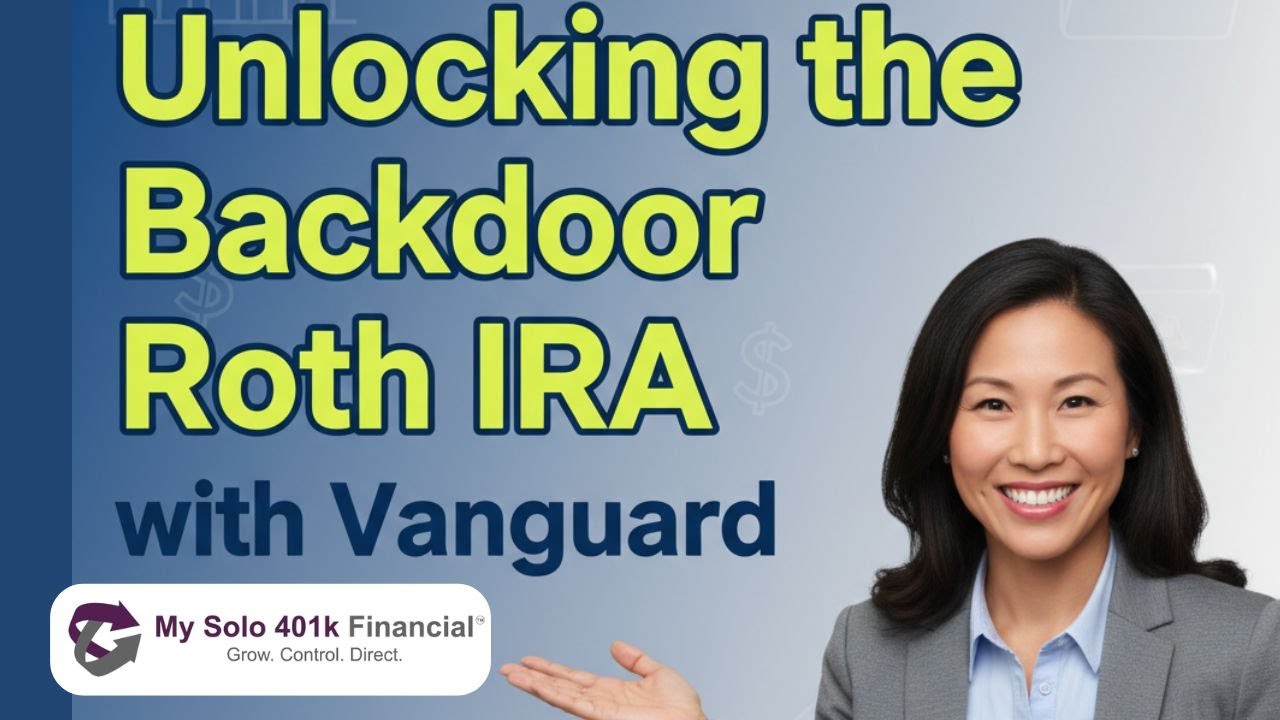

Unlocking the Backdoor Roth IRA @ Vanguard: How to Use Reverse Rollovers to Avoid the Pro-Rata Rule
The Backdoor Roth IRA is a powerful strategy for high-income earners to contribute to a Roth IRA, even if their income exceeds the direct contribution limits. But, the dreaded “pro-rata rule” can significantly diminish its appeal. Fortunately, there’s a solution: reverse rollovers. This article will guide you through the process of using reverse rollovers at Vanguard to execute a Backdoor Roth IRA and circumvent the pro-rata rule, maximizing your tax-advantaged retirement savings.
Understanding the Backdoor Roth IRA
First, let’s recap the basics. A Backdoor Roth IRA involves two steps:
- Making a non-deductible contribution to a Traditional IRA: Regardless of your income, you can contribute to a Traditional IRA. If you’re over the income limits for direct Roth contributions, you make a non-deductible contribution.
- Converting the Traditional IRA balance to a Roth IRA: You then convert the money in your Traditional IRA to a Roth IRA. The conversion is a taxable event, but the future earnings in your Roth IRA grow tax-free and are tax-free in retirement.
The Pro-Rata Rule: The Backdoor’s Potential Pitfall
Here’s the catch. The IRS applies the pro-rata rule when calculating the taxable portion of your Roth conversion. This rule states that if you have any pre-tax money in any Traditional, SEP, or SIMPLE IRAs, the conversion will be taxed proportionally based on the ratio of after-tax (non-deductible) money to your total IRA assets.
Example:
Let’s say you want to contribute $6,500 to a Backdoor Roth IRA in 2023. You make a non-deductible contribution of $6,500 to a Traditional IRA. However, you already have $65,000 in a pre-tax Traditional IRA.
- Your total IRA balance: $65,000 (pre-tax) + $6,500 (after-tax) = $71,500
- Percentage of after-tax money: $6,500 / $71,500 = 9.09%
When you convert the $6,500, only 9.09% ($591) will be tax-free. The remaining $5,909 will be taxed as ordinary income, defeating the purpose of the Backdoor Roth IRA.
Reverse Rollovers: The Solution to Avoid the Pro-Rata Rule
The solution to avoid the pro-rata rule is to eliminate the pre-tax money from your Traditional, SEP, and SIMPLE IRAs before you perform the Roth conversion. This is where reverse rollovers come in.
A reverse rollover (also known as a 401(k) rollover) involves moving your pre-tax IRA assets into a qualified retirement plan, such as a 401(k), 403(b), or Thrift Savings Plan (TSP), offered by your employer. This effectively reduces your IRA balance to only contain the non-deductible contributions, making the subsequent Roth conversion virtually tax-free.
Using Reverse Rollovers at Vanguard: A Step-by-Step Guide
Here’s how to execute a reverse rollover at Vanguard and perform a Backdoor Roth IRA:
- Confirm 401(k) Eligibility: Ensure your employer-sponsored 401(k) plan accepts rollovers from Traditional IRAs. Check your plan documents or contact your HR department.
- Make a Non-Deductible Contribution to a Traditional IRA at Vanguard: Log in to your Vanguard account and open a Traditional IRA (if you don’t already have one). Contribute the maximum non-deductible amount ($6,500 in 2023, $7,500 if age 50 or older).
- Contact Vanguard to Designate the Contribution as Non-Deductible: After making the contribution, contact Vanguard’s customer service to designate it as non-deductible. This is crucial for accurate tax reporting. You’ll need to file Form 8606 with your tax return.
- Initiate the Reverse Rollover from Vanguard to Your 401(k):
- Contact Vanguard’s rollover department.
- Inform them you want to roll over your entire Traditional IRA balance into your employer’s 401(k) plan.
- They will likely require documentation from your 401(k) plan confirming they accept rollovers.
- Complete the necessary paperwork and follow Vanguard’s instructions.
- Confirm the Rollover: Once the rollover is complete, verify with both Vanguard and your 401(k) provider that the funds have been successfully transferred.
- Convert the Remaining Traditional IRA Balance to a Roth IRA: Now that your Traditional IRA contains only the non-deductible contribution, you can convert it to a Roth IRA within Vanguard. This conversion should be largely tax-free.
- Report on Form 8606: When you file your taxes, be sure to fill out Form 8606 to report the non-deductible contribution and the Roth conversion.
Important Considerations:
- Timing: Try to perform the reverse rollover and Roth conversion as soon as possible after making the non-deductible contribution to minimize any earnings or losses in the Traditional IRA, which would be subject to tax upon conversion.
- Form 8606: Accurate completion of Form 8606 is critical. It documents your non-deductible contributions and the Roth conversion, ensuring the IRS properly calculates your taxes.
- Employer Plan Limitations: Not all 401(k) plans accept rollovers from IRAs. Confirm eligibility before proceeding.
- Tax Advisor: Consult with a qualified tax advisor to ensure the Backdoor Roth IRA and reverse rollover strategy are appropriate for your individual circumstances.
Conclusion
The Backdoor Roth IRA is a valuable tool for maximizing retirement savings. By understanding and utilizing reverse rollovers, you can effectively navigate the pro-rata rule and unlock the full potential of this strategy at Vanguard. By following the steps outlined above and seeking professional advice, you can pave the way for a tax-advantaged retirement future. Remember to diligently track your contributions and conversions and consult with a tax professional to ensure compliance with IRS regulations. Good luck!
LEARN MORE ABOUT: IRA Accounts
INVESTING IN A GOLD IRA: Gold IRA Account
INVESTING IN A SILVER IRA: Silver IRA Account
REVEALED: Best Gold Backed IRA



0 Comments