What if earnings accrue in the after-tax account before you're able to do the in-plan conversion to the Roth 401k sub-account or transfer it out to a Roth IRA? How is that handled?
I assume the bulk of Roth Conversions should be before 65, to avoid medicare surcharges and stay at your lowest tax bracket. I understand the advantage of converting to Roth and paying taxes during 60-65, allows the money to then grow tax free after that.. however, maybe by 75 the portfolio has reduced such that the RMD amounts/taxes doesn't matter?
What's the disadvantage of moving all the 401K to a traditional IRA? This way, every year you have the OPTION of moving from 401K to a Roth IRA (the ladder amount will be to stay under 22% taxes Although if you do this, you no longer have Backdoor Roth IRA.. i.e. If you have any after-tax contributions in your 401k, you can roll just the after-tax portion to a Roth IRA and the pre-tax portion to a traditional IRA (a "mega backdoor Roth"). . Is there an online calculator that can help with these kinds of strategies? HonestMath is nice (monte-carlo) but doesn't have any inputs for minimizing taxes!
Do you have a video where you cover the reason a mega BDR doesn’t work for people with employees? More importantly do you have one that covers the options to get around it?
If I understand it correctly you can structure a dual 401k offering. 1 plan for executives and a different plan for employees. The executive plan could be for high earners, CEO, CFO, COO, VP’s etc and include IRA matching funds designed to hit the max contribution limit. In a family business many of these roles are likely held by members of the family. Even if they aren’t family the 401k package would be factored into their salary. Can you break down how this really works and let me know if I am way off base? (Obviously everyone must actually do the jobs they are paid for unless you want to take a gray bar vacation courtesy of the IRS)
The best explanation of Mega Backdoor Roth on the Internet. Other clips don't lay out the steps needed to execute the plan alongside the pre-tax contribution. Thanks!
One important note: Many (most) employer plans don't allow rollovers of Roth 401k to Roth IRAs while you are working there, but do allow After-Tax to Roth IRA rollovers (Option 2 5:50). After seasoning in the Roth IRA for 5 years, the original contributions can be taken out tax and penalty free regardless of age, making this the ultimate savings account.
Personally I only make After-Tax 401k contributions and roll them over to Roth IRA each year, I do have to pay ordinary income tax on the earnings from the After-tax account each year, but that is fine and pretty low. I am not stuck to my employer plan this way.
I seriously doubt 40-50% of plans managed by providers/administrators allow after tax contributions in such a fashion. At least I’ve never stumbled onto one myself, despite switching 6-7 jobs over the past 15 years
Never understood looking money up. Just invest the 23.5k into a fund that can generate 5x what a normal generic 401k offers. You beat the company match anyways. Reinvest the profit into a Roth IRA and rinse, wash, and repeat.
My plan capped me at 45.5k of total contributions. Because I am “high income earner” what do I need to ask the 401k provider / TPA to figure out how to get the other 24.5k into my plan?
I am 60 & tried this but my employer said NO I have to retire before I can touch my account. I have talked with several financial experts and they said I can not touch it. I feel something is a miss. HELP ME PLEASE.





You’ve explained it better that ChatGPT and countless other YouTube videos
What about with a SEP?
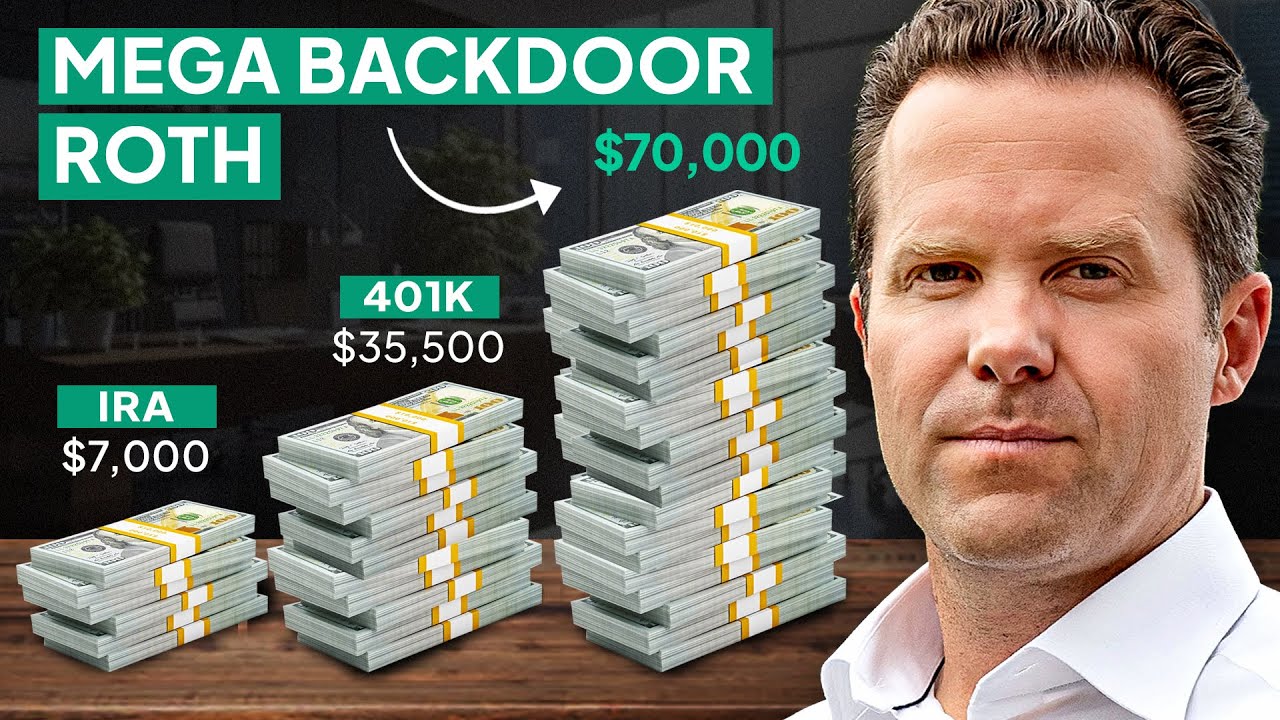
How do you determine the maximum contribution limit for the Mega Backdoor Roth? For simplicity sake, let's use an example with some simple numbers…
Let's say for 2025, your 1099 income is $100k. You have an S-corp and pay yourself a wage of $50k.
Minus the self-employment taxes, can you contribute only your full wage of $50k to this After-tax Non-Roth subaccount?
Or, since your business brought in $100k for the year, can you contribute the 2025 maximum of $70k to this After-tax Non-Roth subaccount?
Thanks in advance for your help!
What if earnings accrue in the after-tax account before you're able to do the in-plan conversion to the Roth 401k sub-account or transfer it out to a Roth IRA? How is that handled?
I assume the bulk of Roth Conversions should be before 65, to avoid medicare surcharges and stay at your lowest tax bracket. I understand the advantage of converting to Roth and paying taxes during 60-65, allows the money to then grow tax free after that.. however, maybe by 75 the portfolio has reduced such that the RMD amounts/taxes doesn't matter?
What's the disadvantage of moving all the 401K to a traditional IRA? This way, every year you have the OPTION of moving from 401K to a Roth IRA (the ladder amount will be to stay under 22% taxes Although if you do this, you no longer have Backdoor Roth IRA.. i.e. If you have any after-tax contributions in your 401k, you can roll just the after-tax portion to a Roth IRA and the pre-tax portion to a traditional IRA (a "mega backdoor Roth").
.
Is there an online calculator that can help with these kinds of strategies? HonestMath is nice (monte-carlo) but doesn't have any inputs for minimizing taxes!
Do you have a video where you cover the reason a mega BDR doesn’t work for people with employees? More importantly do you have one that covers the options to get around it?
If I understand it correctly you can structure a dual 401k offering. 1 plan for executives and a different plan for employees. The executive plan could be for high earners, CEO, CFO, COO, VP’s etc and include IRA matching funds designed to hit the max contribution limit. In a family business many of these roles are likely held by members of the family. Even if they aren’t family the 401k package would be factored into their salary. Can you break down how this really works and let me know if I am way off base? (Obviously everyone must actually do the jobs they are paid for unless you want to take a gray bar vacation courtesy of the IRS)
The best explanation of Mega Backdoor Roth on the Internet. Other clips don't lay out the steps needed to execute the plan alongside the pre-tax contribution. Thanks!
Why are you talking so fast?
One important note: Many (most) employer plans don't allow rollovers of Roth 401k to Roth IRAs while you are working there, but do allow After-Tax to Roth IRA rollovers (Option 2 5:50). After seasoning in the Roth IRA for 5 years, the original contributions can be taken out tax and penalty free regardless of age, making this the ultimate savings account.
Personally I only make After-Tax 401k contributions and roll them over to Roth IRA each year, I do have to pay ordinary income tax on the earnings from the After-tax account each year, but that is fine and pretty low. I am not stuck to my employer plan this way.
Not clear on account names and questions to ask
I seriously doubt 40-50% of plans managed by providers/administrators allow after tax contributions in such a fashion. At least I’ve never stumbled onto one myself, despite switching 6-7 jobs over the past 15 years
Never understood looking money up. Just invest the 23.5k into a fund that can generate 5x what a normal generic 401k offers. You beat the company match anyways. Reinvest the profit into a Roth IRA and rinse, wash, and repeat.
How the heck is 4% equal to 12k
My plan capped me at 45.5k of total contributions. Because I am “high income earner” what do I need to ask the 401k provider / TPA to figure out how to get the other 24.5k into my plan?
I am 60 & tried this but my employer said NO I have to retire before I can touch my account. I have talked with several financial experts and they said I can not touch it.
I feel something is a miss.
HELP ME PLEASE.
4:58 question, what is the form you’re referring to at option 1 with in plan Roth conversion?