
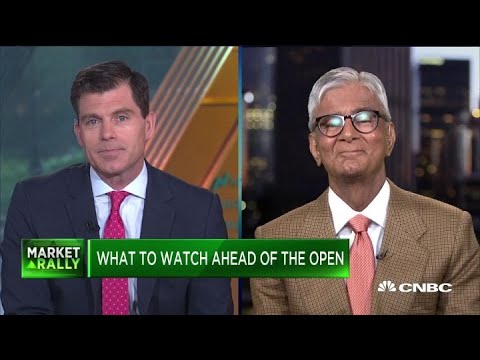

Expect a U.S. Recession by Mid-2020: Insights from Strategist Sri Kumar
As the global economy navigates the complexities of geopolitical tensions, trade agreements, and monetary policy shifts, economists and strategists are keenly observing indicators that could signal the next economic downturn. Notably, Sri Kumar, a respected strategist and market analyst, has predicted a U.S. recession by mid-2020. In this article, we delve into Kumar’s insights, the reasoning behind his forecast, and the potential implications for investors and the broader economy.
The Economic Landscape
In the years leading up to 2020, the U.S. economy was experiencing a period of expansion characterized by low unemployment rates, steady GDP growth, and increased consumer spending. However, several warning signs began to emerge, prompting analysts to reconsider the sustainability of this growth trajectory.
Kumar argues that the combination of slowing global growth, rising interest rates, and ongoing trade disputes—primarily between the U.S. and China—could catalyze a downturn in the U.S. economy. He emphasizes that while the expansion seemed robust on the surface, underlying vulnerabilities may expose the economy to shocks that could lead to a recession.
Key Indicators of a Potential Downturn
-
Yield Curve Inversion: One of the most closely monitored indicators of an impending recession is the yield curve, which reflects the relationship between short-term and long-term interest rates. When short-term rates exceed long-term rates, it signals investor pessimism about future economic growth. Kumar highlights recent instances of yield curve inversion as a fundamental warning sign.
-
Global Economic Slowdown: The interconnectedness of today’s economies means that events abroad can spill over into the U.S. market. Kumar points out that sluggish growth rates in Europe and Asia, coupled with trade friction, are likely to dampen U.S. exports and business investment, which could contribute to a domestic recession.
-
Consumer Confidence and Spending: As consumers drive a significant portion of the U.S. economy, any decline in confidence can have profound implications. Kumar notes that uncertainties stemming from political turmoil, rising costs, and shifts in job security could erode consumer confidence, leading to decreased spending and, consequently, slower economic growth.
- Monetary Policy Adjustments: The Federal Reserve’s monetary policy decisions are critical in shaping economic conditions. Kumar asserts that ongoing increases in interest rates, aimed at curbing inflation, could inadvertently stifle economic growth by making borrowing more expensive for both businesses and consumers. If the Fed continues down this path without acknowledging the growing risks, the result could be an economic contraction.
The Impact on Markets and Investments
For investors, Kumar’s forecast carries significant implications. As fears of a recession grow, there may be a shift in market dynamics and asset allocations. Investors typically gravitate towards safer assets during periods of uncertainty, which may result in increased demand for defensive stocks, Treasury bonds, and gold.
Kumar advises portfolio diversification and caution in sectors most vulnerable to economic slowdowns, such as consumer discretionary and industrials. High-yield bonds may also pose risks as credit spreads widen in anticipation of higher default rates in a recessionary environment.
Conclusion
Sri Kumar’s prediction of a U.S. recession by mid-2020 serves as a reminder of the economic cycles that shape our financial landscape. While the potential for a downturn raises concerns, it also presents opportunities for informed investors to reassess their strategies and manage risk effectively. As we move toward 2020, the interplay of economic indicators and global developments will be critical in shaping the future of the U.S. economy.
As always, staying informed and adaptable will be essential for navigating the uncertainties ahead.
BREAKING: Recession News
REVEALED: Best Investment During Inflation
HOW TO INVEST IN GOLD: Gold IRA Investing




This recession is most likely the result of an external factor. For the first time in decades, the United States is losing its clout as a federal reserve currency. They don't have any more economies to use to control inflation, and less money is being spent on stock and oil trading than in the past. They all lend support to the idea that a new multilateral world order is in the works.
This was so true
He was right!
one of the few guys on TV who actually got it right…as opposed to the talking heads who simply regurgitate what has actually happened
This man hit bulls eye.
Yes
The guest was deadly accurate.
LOL
Sri was spot on prophetic, covid-19 is only a trigger.
Basically the reason we are at a 1999 disposable income is due to 8 years of Obama crippling rule. he really hurt us.
Lol and he was correct the interest rates are now below 1 on the ten year
If anyone dare to put in effort to align short term interest rate, short term yield 2 yrs, and inversion of yield curve, and unemployment rate VS index of u.s. Then u can see that Sri is on the right side of forecasting, the peak of index always happens at with high employment rate… and ended just after fed fund rate being cutting again.. the bond market signal. the demand and supply of loanable funds influence bond yield.. which influence the fed fund rate… that is all an effect of economy health. it is always at the final stage where people like Joe are screaming with euphoria trying to buy on greed and listen to media too much.. JOE, even if ur points are right, are there something that u just dont know? are there something that u know that actually u dont know?
joe is a typical retailer who is shallow and doesnt see the truth of market mechanism. joe is sitting on the basis that bulls are stronger than bears, and that the long term trend is difficult to change. he is right in that sense. but joe should also be flexible and open minded enough to agree just as ray dalio and warren buffett that market in the long term does have a cycle. that is the basic dynamics of market , it has always been and will always be due to human nature and the effect of debt spiral. i agree with Sri , to have pointed out just as ray dalio and warren buffett did that the market is in its late stage. but timing, as we understood as a mature investor, that timing is difficult. but Sir's idea is on the right side. Joe, u got to open up.
Multiple jobs probably doesn't include military reserves 1.1 million people. Don't let fact get in the way of your equity sales
Black October 2020?
READ THE AGE OF OVERSUPPLY. TOO MANY FACTORIES WORLD WIDE, TOO MANY SLAVE WORKERS, MFG. TOO MUCH AND TOO FEW CONSUMERS= CHRONIC SICK ECONOMIES.
Kumar was wrong
When all else fails ….take them to war!!!!! We’re collapsing folks.
Sri is so very surgical in the way he articulates his points. Brilliant!
Recession, they had been saying that since 2010. Meanwhile the market is just keeping going up.
The host is whistling past the graveyard.
watching old and experienced people talk helps us to understand certain things in depth faster than normal pace.
People should hold tight and be prepared for the worst ride of their life; it is going to be worse than 2008. I would advice to save more money, but that would be too little and too late.
The tax cut and deficit would weak the economy and eventually cause a recession.
if the federal deficit is announced in January the world will go into shock with us.the debt in the u.s. can never be paid off, the earth will cease to be, but the debt will remain.
I hope it hit..And hits hard