

Vanguard’s Sobering Forecast: 10-Year Investment Return Projections Get a Reality Check
Vanguard, the titan of low-cost investing, has a habit of being bluntly honest. And their latest 10-year investment return projections are, to put it mildly, sobering. Prepare for a reality check: the coming decade isn’t shaping up to be a repeat of the roaring 2010s.
Forget the double-digit gains many investors have grown accustomed to. Vanguard’s economists are painting a picture of lower returns across the board, driven by a complex interplay of factors including high inflation, rising interest rates, and stretched valuations in certain markets.
The Numbers Don’t Lie (Even if You Don’t Like Them)
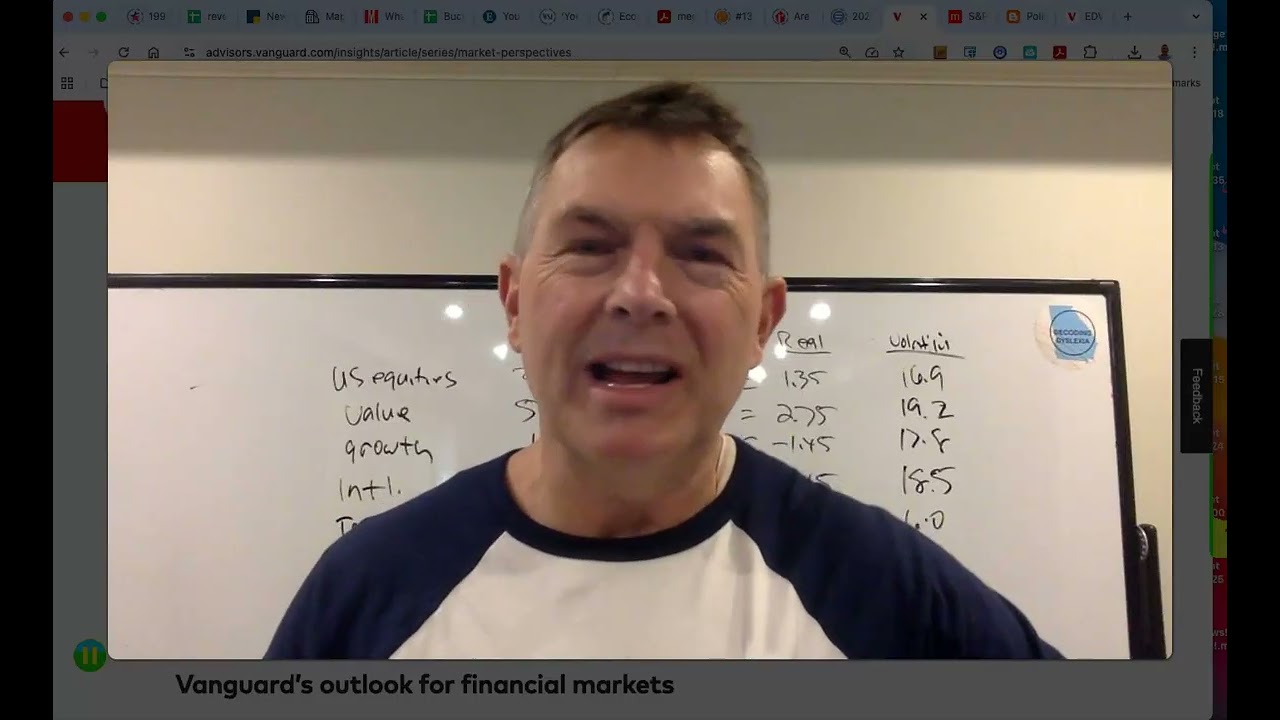
According to Vanguard’s latest projections, US stocks are expected to deliver average annual returns in the 4.7% to 6.7% range over the next decade. That’s a significant drop from the averages seen in the past decade, and it’s a trend echoed across global markets.
International stocks, while potentially offering slightly higher returns in the 6.8% to 8.8% range, come with their own set of challenges, including currency risk and geopolitical uncertainty.
Even bond investors shouldn’t expect to celebrate just yet. Vanguard projects US bonds to yield around 4.5% to 5.5% annually over the next decade, a welcome improvement from near-zero interest rates, but still hardly a wealth-generating bonanza.
Why the Gloom? A Perfect Storm of Headwinds
So, what’s fueling this pessimistic outlook? Several factors are at play:
- Inflation Still Lingers: Despite recent declines, inflation remains stubbornly above central bank targets. This forces central banks to maintain higher interest rates, dampening economic growth and impacting corporate earnings.
- Rising Interest Rates: As interest rates rise, borrowing costs increase for businesses and consumers alike. This can slow down economic activity and put downward pressure on stock valuations.
- High Valuations: After years of market exuberance, particularly in the tech sector, valuations in some areas remain stretched. This suggests limited potential for further price appreciation.
- Geopolitical Risks: The world is a volatile place. Ongoing conflicts, trade tensions, and political instability all contribute to uncertainty and can negatively impact investment returns.
What Does This Mean for Investors? Time to Adjust Your Sails
Vanguard’s projections aren’t meant to scare you into selling everything and hiding under a mattress. Instead, they’re a call to action, urging investors to:
- Lower Your Expectations: Don’t expect the past decade’s returns to repeat themselves. Adjust your financial goals and savings plans accordingly.
- Review Your Asset Allocation: Make sure your portfolio is appropriately diversified across different asset classes (stocks, bonds, real estate, etc.) to manage risk and potentially enhance returns.
- Focus on Cost Efficiency: Minimize investment expenses by utilizing low-cost index funds and ETFs, like those Vanguard is known for. Every dollar saved in fees is a dollar that can contribute to your returns.
- Consider Value Investing: With growth stocks potentially facing headwinds, exploring value investing strategies might be prudent. Look for undervalued companies with strong fundamentals.
- Don’t Panic: Market volatility is inevitable. Resist the urge to make emotional decisions based on short-term market fluctuations. Stay disciplined and stick to your long-term investment plan.
- Stay the Course: Investing is a marathon, not a sprint. Long-term investing is about weathering the storms and focusing on the big picture.
The Silver Lining: A More Realistic Landscape
While Vanguard’s projections may sound discouraging, they ultimately offer a more realistic view of the investment landscape. By understanding the challenges and adjusting your expectations, you can position yourself for long-term success, even in a less exuberant market environment.
Remember, even moderate returns, compounded over time, can still lead to significant wealth accumulation. It’s all about planning, discipline, and staying the course. So, take a deep breath, review your portfolio, and prepare for a potentially bumpy, but ultimately rewarding, investment journey.
LEARN MORE ABOUT: IRA Accounts
INVESTING IN A GOLD IRA: Gold IRA Account
INVESTING IN A SILVER IRA: Silver IRA Account
REVEALED: Best Gold Backed IRA



So for the retirement tools should the expected return be based on forecasted 10 year returns or should they be based on longer forecast. If you push the forecast to 15-year then it might be bad for 10 years but then likely recover some over the next 5 years. That is the trick is finding what is a reasonable average retirement return. I used portfolio visualzer and look at the Rolling Return for their Asset Class Allocation for 15 years. I think that moderates the returns project more than using a 10 year forecast.
Bottom feeders usually come out ok. Panic selling is good money making opportunity.
"Over the past decade, the VCMM has tended to underestimate U.S. equity returns. For example, Vanguard's projections for U.S. large-cap stocks were lower than the actual returns realized during this period. This discrepancy has been attributed to unexpected valuation expansions, where investors were willing to pay higher prices for future earnings, especially in a low-growth, low-interest-rate environment."
"While the VCMM serves as a useful tool for setting reasonable expectations and informing investment strategies, its forecasts are not infallible. Investors should use these projections as one of several inputs in their decision-making process, remaining mindful of the inherent uncertainties in financial markets."
Sold all my stocks.. bought Buffer ETF's to participate in the market.. PGIM has funds that give you either 12 or 20% downside protection , with a 13 or 9 % upside cap, respectfully. PBMR resets March 1..
Got 6.2% MYGA's guaranteed from direct buy Canvas annuity. Nothing is as overvalued as the SP500, especially Tesla at 165 PE !!!!
Markets are cyclical, the last 10 years have been very over the past 10 years. The historical data suggests things will cool off. BTW, in the short term tariffs will cause some pain. After all suddenly we will have to pay more on certain items we import. However, in many instances it will take time for US manufacturers to fill the gap created by tariffs. During the US production gap prices will most likely increase. Of course in the long term the tariffs will mean more jobs and wealth creation.
Good stuff. I will say nobody has a crystal ball. Vanguard always comes out with projections because it gets people‘s attention and it’s good publicity for them. All BS in my opinion.
Hard to do much if you have a 401k at Vanguard. Most have to just roll with it unless change to bonds which ain’t doing squat either. I guess the trick is sign it all over to a paid professional and let them invest your retirement.
Food for thought and interesting data.
A few weeks ago the long treasury nudged 4.95%. I was lucky to deploy $ and grabbed 25 twenty year and 30 thirty year maturities at a nice discount. The payment on both maturities is 4.5%. I’m happy with this trafe
There was a guy like this, saying some BS like this, on a video like this, 10 years ago.
We invest for the future, not the past. No one knows what the future holds.
I’m just curious as to which international areas are going to give that sort of return. Nearly every western country, and China, economies are in trouble. Germany is either in a recession or barely above one, France and Italy aren’t much better so it can’t be Europe. Canada… toast. China, in trouble and any country tied to them ( Australia, Chile, Brazil) are in trouble today and if they lose China then they’ll go down quicker than the Titanic.
So which part of the international market is going to give that sort of return?
The 1970s were pretty bad. The S&P500 was lower in 1981 than in 1970.
Didn't Bogle predict 3% market returns?
And we've had two 20% Plus back-to-back years?
Vanguard has been wrong for a long time with 10 year projections a lot lower than they have been on US stocks and international stocks they projected higher. I have read all of Josh's books and have also paid for two of his online courses. Only regret I wish I knew Josh 20 years ago. When your nearing retirement make sure and rebalance stock/bond allocation in your portfolio so you do not get caught in a big downturn when retiring. Thanks Josh for all you do. God Bless you
Why do they think international will outperform US?
Have their predictions in the past been accurate? Maybe it's just a legal thing they have to warn you that you could lose money or make very little.
The thing about the standard deviation figures, if you want a 95 confidence interval, you will be +/- 2 standard deviations, or a loss of up to almost 40% to a gain of 40%. Everyone is OK with a 40% gain, but get one of those 40% loss years, and it will test your resolve. And you can get multiple bad years in a row (or good years in a row). I retired in 2007, and in the next two years, my nest egg dropped over 60%. That was pretty rough! Almost all retirees overlook the amount we all have in a fixed rate, guaranteed return, with automatic annual adjustment for inflation. This device is your social security check. Investigate a guaranteed, immediate annuity that pays out what you get in social security every month. It's a shocking high number. And most annuities will not have automatic, annual, inflation adjustment.
Vanguard has been very conversation in their past forecasts too. Go back and compare their forecasts and what we actually got the past few years.
From 1966 to 1982, the S&P stock market was in a sideways market that traded from 1050 to 700 and from 700 to 1050 for 16 years. Also during this same period, interest rates increased from 4.5% to 15%? Learning to trade stocks and buying good fixed income investments during this 16 year period was the best way to invest.
If the S&P stock market peaks in 2025 at lets say 6500, could it be possible that we drop to lets say 3000, and then we enter a sideways market for 10 to 15 years. This sideways market could trade from 6500 to 3000 and from 3000 to 6500 for 10 to 15 years. Learning to trade stocks and buying good fixed income investments during this 10 to 15 year period may become the best way to invest. What do you think?
Just some food for thought.
Since the market is so unpredictable, I will not be risking my portfolio chasing higher returns upon retirement. Although relatively low RORs, almost everything I own is guaranteed positive returns except my 457(b), which is just play money for me. So I'll risk that, but I won't pull even a portion of my money from my DROP account trying to get an extra couple of percentage points higher ROR.
Was the analyst at Vanguard getting USAID money or what? Seems fairly anti USA.
What goes up must go down. Things have been very up.
Good points Josh ..! Yup PAWed the like button..!
GIGO
This is an unusually disruptive time period which will cause companies and institutions that are unable or unwilling to adapt to the new technologies to fail.
US corporations as a whole are better suited than Europe and most of the world sans China to thrive via AI, electrification etc. ( Though China has a major debt problem because their debt is in US denominated dollars, not RMB).
This is the best time in history to pick individual stocks. Europe has committed bureaucratic suicide by rejecting electrification and AI.
The companies that thrive in this environment will grow to sizes that are currently unimaginable.
What was their predictions/projections for prior 10 years?,i.e how accurate have they been in the past?
Meh, I'm sticking to what I've been doing.
Big question is will the large tariffs be enacted or are they just being used to bargain for reciprocal tariffs.
When I use cash locally, venders are giving me a 5% discount on my purchases
No one can predict the stock market.
I haven't heard a good reason for Tariffs in Canada. China, yes. Mexico? Perhaps.
Looks like Vanguard is telling you to not use their services and withdraw your money… just buy US Treasuries. I guess they are telling us they will be out of business soon as I can see no reason to invest in their products based on what they are saying.
Thanks Josh! I've heard these dismal projections from Vanguard and others the past several years. Eventually they will be correct for a year or more, but who knows? I maintain a 60 equity / 30 bond / 10 cash allocation overweight on LC Value (LCValue 40, LCBlend 30, LCGrowth 5). 67 yo and retiring this year.
In Covid lockdowns they warned to not expect more than 5.5 percent returns but was fortunately not the case for me
Vanguard…???? That's Your First Problem….!!! LOL.
Being diversified is the key don't stop!
Thank you Josh !!
Maybe they give too much weight to the CAPE ratio…CAPE is saying single digits for the next 10 yrs
What does VG see happening with small and mid cap stocks?
Josh VTI still looks good