
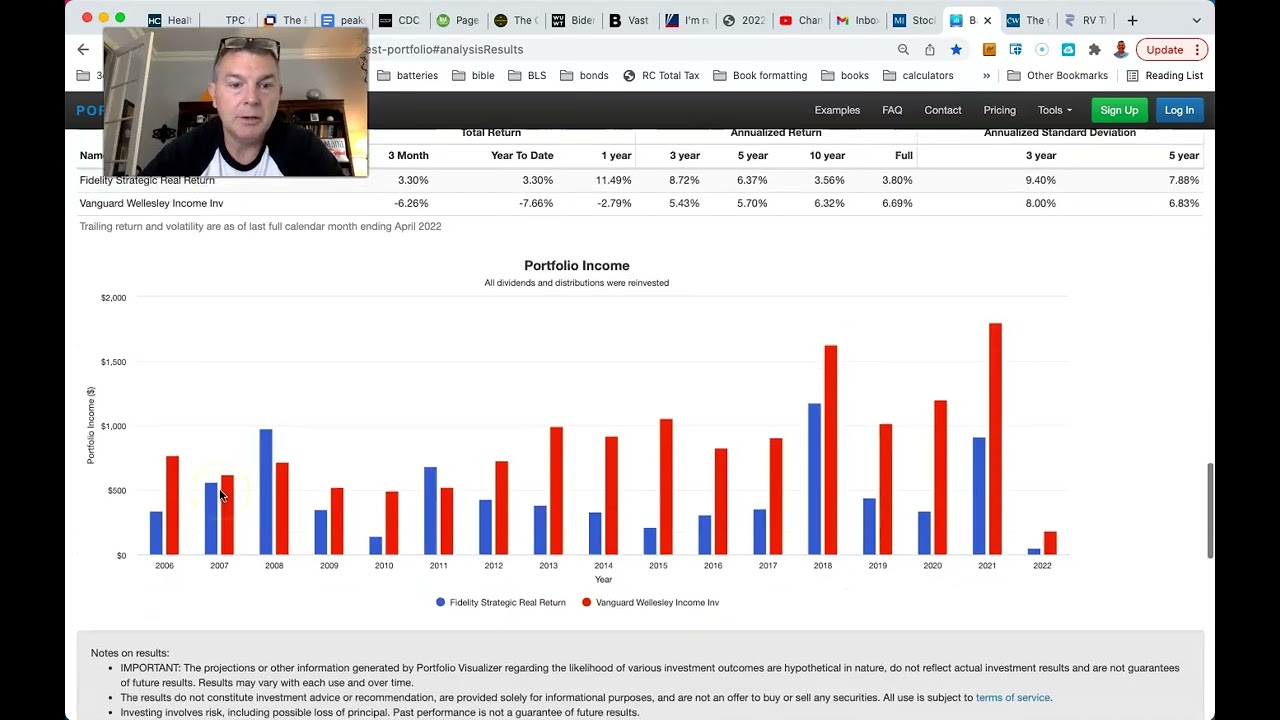

Vanguard Wellesley vs. Fidelity Strategic Real Return: A Comparative Analysis
When it comes to investing in mutual funds, making informed decisions is crucial to achieving financial goals. Vanguard Wellesley Income Fund and Fidelity Strategic Real Return Fund are two popular options that appeal to different investor preferences. This article will provide a comparative analysis of these two funds, examining their investment objectives, strategies, risk profiles, and performance.
Overview of Vanguard Wellesley Income Fund
Vanguard Wellesley Income Fund (VWINX) is known as a balanced fund that primarily invests in a mix of income-generating securities, including both stocks and bonds. With a large allocation towards bonds, this fund aims to provide investors with both capital appreciation and income generation. The typical asset allocation is about 60% bonds and 40% stocks, making it a conservative option for income-focused investors.
Investment Objectives: The fund seeks to provide a moderate level of income along with long-term capital appreciation. Its balanced approach makes it particularly attractive for retirees or conservative investors looking for stability in their portfolios.
Investment Strategy: The fund employs a disciplined investment strategy that includes investing primarily in high-quality, dividend-paying stocks and investment-grade bonds. Vanguard’s management team actively monitors market conditions to adjust the portfolio in response to market volatility and interest rate changes.
Risk Profile: While Vanguard Wellesley Income Fund is generally considered low to moderate risk due to its focus on bonds and dividend-paying stocks, it is still subject to market fluctuations, interest rate risk, and inflation risk. Investors should be aware that the bond component may underperform in a rising interest rate environment.
Overview of Fidelity Strategic Real Return Fund
Fidelity Strategic Real Return Fund (FRRGX), on the other hand, has a distinctly different focus. This fund aims to provide investors with real returns, taking inflation into account. It invests in a diversified portfolio of inflation-protected securities, commodities, real estate, and other assets that tend to increase in value during inflationary periods.
Investment Objectives: The fund’s primary goal is to achieve a total return that exceeds the rate of inflation over the long term. This makes it an appealing option for investors concerned about inflation eroding their purchasing power.
Investment Strategy: Fidelity employs a multi-asset approach to achieve its investment objectives. The fund invests in U.S. Treasury Inflation-Protected Securities (TIPS), commodities, and global real estate investment trusts (REITs). The active management strategy allows the fund’s managers to adjust allocations based on market conditions and inflation expectations.
Risk Profile: Due to its focus on commodities and real assets, Fidelity Strategic Real Return Fund comes with a higher risk profile compared to Vanguard Wellesley. Factors like commodity price volatility, currency risk, and geopolitical tensions can impact performance.
Performance Comparison
When assessing performance, investors should consider the time horizon, market conditions, and individual financial goals. Historically, Vanguard Wellesley has provided steady returns with relatively low volatility, making it suitable for conservative investors seeking income. On the other hand, Fidelity Strategic Real Return has offered the potential for higher returns during inflationary periods but comes with greater volatility and risk.
Fees and Expenses
Another important aspect to consider is the fee structure. Vanguard is known for its low expense ratios, which can be a significant advantage for long-term investors. Vanguard Wellesley typically has a lower expense ratio than Fidelity Strategic Real Return, which can contribute to better net returns over time. Fidelity, while offering a quality product, may have slightly higher costs associated with active management.
Conclusion
Choosing between Vanguard Wellesley Income Fund and Fidelity Strategic Real Return Fund ultimately comes down to the individual investor’s goals, risk tolerance, and investment timeline. Vanguard Wellesley is better suited for conservative investors seeking income and stability, while Fidelity Strategic Real Return appeals to those who are more concerned about inflation and are willing to accept higher risk in exchange for potential growth.
As with any investment decision, it’s wise to conduct thorough research and consider consulting with a financial advisor to determine the best fit for your specific financial situation.
LEARN MORE ABOUT: IRA Accounts
INVESTING IN A GOLD IRA: Gold IRA Account
INVESTING IN A SILVER IRA: Silver IRA Account
REVEALED: Best Gold Backed IRA




What if we have funds at fidelity, what it a good fund?
You can do a bit better than Wellesley by creating your own 60/40 fund with FTBFX (60%) and FXAIX (40%)…
Low expenses and index funds in taxable accounts and bond funds or active stock funds in non taxable accounts. Then Diversification, but the most important thing is not wealth but health is because once you lose that all the money cannot buy it!
This is what Fidelity did to me many years ago in a fund called Asset Manager, it was loaded up with Mexican debt that went bad. Janus screwed me too.
Heavily in VWINX and VBIAX, along with some large value and high dividend funds. Was not hitting the outsize returns over the last few years, but also not getting crushed during the current downturn. Most importantly I am not losing sleep over the market gyrations either, and that is the most important factor of all.
Stop chasing returns is the big message for everyone. Most of the time the return isn't what holding people back. Most people just don't save enough money and because they don't they try to squeeze more return out of their portfolio.
Great comparison, Josh. I'd love to see what your thoughts are on Vanguard Value Index Fund Admiral Shares (VVIAX) compared to Wellesley. The expense ratio for VVIAX is less than VWINX (0.05% vs 0.22%). Should that be a consideration?
The expense ratio of the Fidelity fund would be an absolute deal killer for me. I mean here we are in 2022 and they are charging 0.70% to own this fund. No.
Excellent work Josh. Thank You
Good, quick, and clear analysis. Thank you.
Josh — Thanks for the advice! Always great to hear your thoughts!
Wells all the way! Good analysis!
Wow! I was just comparing these two funds last night. Josh, thanks for sharing this.
You can’t fool old Josh!
I am a 46 year old man on SSDI From crush injury at work. I do have a small annuity for rest of my life. My small house is paid off. Kids taken care of. I have $70k in Roth and $185k in brokerage. I like Wellington and Wellesley. But not sure what to do in this situation. Curious on your thoughts. Thanks
Hard to argue with a successful 50+ year history. They don't hit a lot of homeruns but they do hit a lot of singles and doubles. Works for me and it's what we are putting our Roth money into.
I've been heavily in VWINX for over 15 years in my Fidelity IRA and brokerage account. My only complaint is that my Fidelity charges a $75 transaction fee to buy VWINX.