
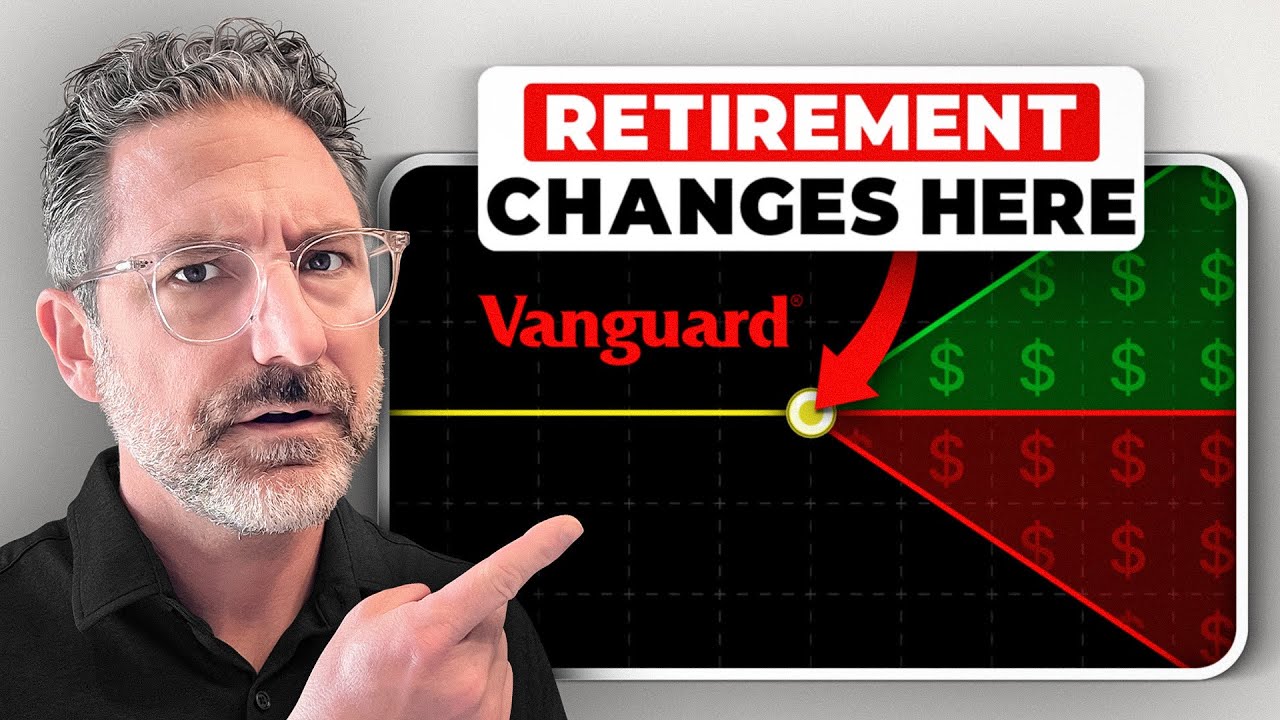

Most People Save Wrong After 55 – Here’s What Vanguard’s Data Shows
For decades, we’ve been told to diligently save for retirement. But accumulating a nest egg is only half the battle. Knowing how to manage those savings after 55 is arguably even more crucial, and surprisingly, many people are getting it wrong.
Vanguard, one of the world’s largest investment management companies, has a treasure trove of data on retirement account behavior. Their insights reveal some common pitfalls that can jeopardize your financial security in your post-work years. Let’s dive into what Vanguard’s data shows and how you can avoid these mistakes.
The Pitfalls: Where Retirees Stumble
Vanguard’s data points to a few key areas where retirees tend to fall short:
-
Over-Investing in Conservative Assets (Too Soon): A common misconception is that you need to drastically shift your portfolio towards ultra-conservative investments like bonds and cash as soon as you hit retirement. While reducing risk is important, overdoing it can significantly limit your portfolio’s growth potential. With increased life expectancy, you could be spending decades in retirement, and your investments need to keep pace with inflation and potentially rising healthcare costs.
- Vanguard’s Take: They’ve found that many retirees underestimate the longevity of their retirement and drastically reduce their equity allocation prematurely. This can lead to slower growth and potentially depleting their savings faster than anticipated.
-
Ignoring Inflation: Inflation is the silent wealth-killer. A seemingly safe fixed income portfolio might not keep pace with rising prices, eroding your purchasing power over time.
- Vanguard’s Take: Their data shows that some retirees focus solely on preservation of capital without considering the impact of inflation on their long-term spending needs.
-
Not Having a Withdrawal Strategy: Dipping into your savings haphazardly can lead to unnecessary tax burdens and the risk of running out of money early.
- Vanguard’s Take: A well-defined withdrawal strategy is essential. Vanguard advocates for strategies that balance maintaining a sustainable income stream with preserving capital. This could involve a percentage-based withdrawal or a sophisticated approach that considers market performance and inflation.
-
Fear of Market Volatility Leading to Poor Decisions: Watching your portfolio fluctuate in value can be nerve-wracking, especially in retirement. Reacting emotionally to market downturns by selling low and buying high can severely damage your long-term returns.
- Vanguard’s Take: They consistently emphasize the importance of staying the course and sticking to a well-diversified portfolio, even during periods of market turbulence. Panic selling often leads to missing out on the subsequent recovery.
How to Save Right After 55: Lessons from Vanguard
Here are some key takeaways from Vanguard’s research that can help you optimize your retirement savings strategy:
-
Maintain a Balanced Portfolio: Don’t ditch equities completely. Even in retirement, a diversified portfolio with a mix of stocks and bonds is crucial for growth and inflation protection. Your allocation should depend on your individual risk tolerance, time horizon, and financial goals. Consider a glide path approach, gradually decreasing your equity allocation as you age.
-
Develop a Sustainable Withdrawal Strategy: Work with a financial advisor or utilize online tools to create a plan that allows you to withdraw income sustainably while preserving your capital. Consider the “4% rule” as a starting point, but adjust it based on your circumstances.
-
Rebalance Regularly: Maintain your target asset allocation by rebalancing your portfolio periodically. This involves selling assets that have performed well and buying those that have underperformed. This helps to control risk and potentially improve returns.
-
Stay Informed and Educated: The financial landscape is constantly evolving. Stay updated on investment strategies, tax laws, and retirement planning best practices. Utilize resources from reputable sources like Vanguard, Fidelity, and Schwab.
-
Consider Professional Guidance: If you’re feeling overwhelmed, consider working with a qualified financial advisor. They can help you create a personalized retirement plan, manage your investments, and navigate the complexities of retirement finances.
The Bottom Line:
Saving for retirement is a marathon, not a sprint. By understanding the common mistakes retirees make and implementing a well-thought-out investment and withdrawal strategy, you can increase your chances of enjoying a financially secure and fulfilling retirement. Don’t fall into the trap of being “too conservative” too soon. Embrace a balanced approach, stay informed, and seek professional guidance when needed. Your retirement deserves it.
LEARN MORE ABOUT: IRA Accounts
INVESTING IN A GOLD IRA: Gold IRA Account
INVESTING IN A SILVER IRA: Silver IRA Account
REVEALED: Best Gold Backed IRA



Just to be helpful, I must point out that 14% of people does not constitute "Most People". Apparently, not contributing to 401k after 55 is NOT a problem most people have. Also, .08% fees for target date funds is perfectly reasonable for people who don't have the wherewithal to rebalance. Again, is this a problem that "most" people have? Do most people have too much cash or company stock? No numbers provided there for us to tell, but if 14% has been defined as most, one can be skeptical. Not one of the more useful videos out here.
Enron should have taught most employees about sinking all their savings into their employer.
Should…
I believe if we had an option to automatically roll over excess contributions over tax advantaged limits to an integrated non advantaged investment account people would do even better. Sure they would likely be better off doing it on their own with more options but just like auto enrollment this would help people make better decisions.
I realized I was overexposed in my company’s stock simply because they match that way, I had about $150k in that single Fortune 200 stock. The stock briefly reached a 50 year high last December and I dumped it to reinvest elsewhere. It’s way off since then and the reinvested money is up over 8% in that period. I NEVER time the market correctly and have learned to not even try, somehow bumbled into doing something right this time.
thank you for this, and totally agreed on these points
How many people stopped contributing to a 401k because their employer did away with the match?
One thing that many of us don’t think about us how much our retirement savings will grow after we retire. I’m 54 and the money that I am investing today isn’t going to grow much between now and when I retire, but it is going to grow a lot in the 25 years that I’m planning on living after I retire!
Don't forget the Super Catchup for those ages 60-63. Up to $34,250.
Were these over-55 people still employed and eligible to contribute to their employer-sponsored 401k? Maybe they stopped working and retired early.
What percent of the 14% have a pension? If they have a pension it would explain why no contributions. When breaking down the numbers most CFP's ignore then when presenting the date which skews how they are presenting the data.
The reduced 401 (k) contribution at 55+ could be due to a shift in post-tax investments to diversify tax strategies.
Forgot to talk about evaluating your 401k contribution % in relation to your max year-end contribution amount…if the percent you have (eg 12%) means you’ll hit your max 8mo into the year, you’ll be missing out on 4 mo of paychecks that would have had free employer match dollars. Tune your contribution % to max out at your last paycheck of the year. For high-dollar earners under 55 that don’t have the extra catchup, this is good practice plus keeps your income steady all 12mo to better budget cash flow vs having a cash flow spike for the last (ex. 4) months only and then drop again come Jan when next year’s 401k bucket starts to refill again.
I'm convinced it's a good idea to have a large chunk of cash ON HAND! I know most "financial experts" do not agree and always use the inflation argument, but if it helps the retiree to sleep at night…what's the problem? Say you have a modest/decent nest egg, over 500K for example. The market gets slammed after you've just retired and you enter into sequence of returns risk.Your 500K is now 350K or less! With cash on hand, YOU DO NOT NEED TO TAP INTO YOUR 401K or IRA. Leave it alone and let it recover! Use your cash surplus instead.
To expand on the issue of holding a large position in an individual stock — and this applies whether or not it's your employer — be aware that the company might be acquired in an "all-cash" deal. What that means is ALL your shares are sold when the transaction closes and you receive cash. In my case I had built up about 100K worth of company stock in my ESPP and stock grants. When the company was bought by Google in an all-cash deal all of that stock was sold which was not something I had been planning on doing. I had a capital gain on the ESPP shares and the stock that had been granted was treated as taxable income — all hitting in one year. I was a mid-level employee — execs who had millions tied up in company stock would have been hit with whopping taxes in the year of the sale.
"Don't Enron"
What helped me was to up my contribution each time I got a raise – I put a portion of my raise in retirement and didn't miss the extra $ that would have been in the paycheck.
I'm annoyed at one required retirement investment where it is a choice of either low interest stable value or high cost target date funds. I cannot move the money unless I stop the job. Fortunately, it's a comparatively small amount but annoying nonetheless. What I did is spread the money over several target funds.
I would never recommend target date funds to anyone. They typically underperform separate appropriately allocated funds, they cost WAY more than most index funds, they tend to be too conservatively allocated, especially for young investors. Don't let your desire for simplicity cost you many thousands of dollars. Pick your own index funds and manage them yourself, it doesn't have to be complicated. It is true that many 401k/403b plans don't have great investment options, mine certainly doesn't, but I was able to find 4 funds, 3 passive and 1 managed, that have worked well for me, and the 3 index funds have very low fees. Only the Active growth fund is high at 0.40%, but it's the only way I could gain access to growth stocks inside the plan. Although I'm good with this arrangement for now, I am very much looking forward to rolling this account over to an IRA when I retire, to gain access to far better investment options.
It would be interesting to hear your thoughts on when it might make sense to not contribute to 401k after age 55, e.g. if you already have a large 401k balance (so compounding is going to have a much bigger impact than more contributions), there is no company match available, income is too high for Roth 401k contributions, and you're either spending the money having some pre-retirement fun or putting it into your cash bucket ready for retirement or into taxable account ready to pay taxes on post-retirement Roth conversions.
thank you for your content sir. youve inspired me to document my own journey on my yt channel
I thought max contribution for 55+ was $8000, not $7500??
When will the sheep finally realize the dooming problem is the fiat currency? If you are not stacking physical SILVER than you will be on the wrong side of history! Side note, you cannot have capitalism inside a fiat system (Remember …Fruit from the poison tree legality)