
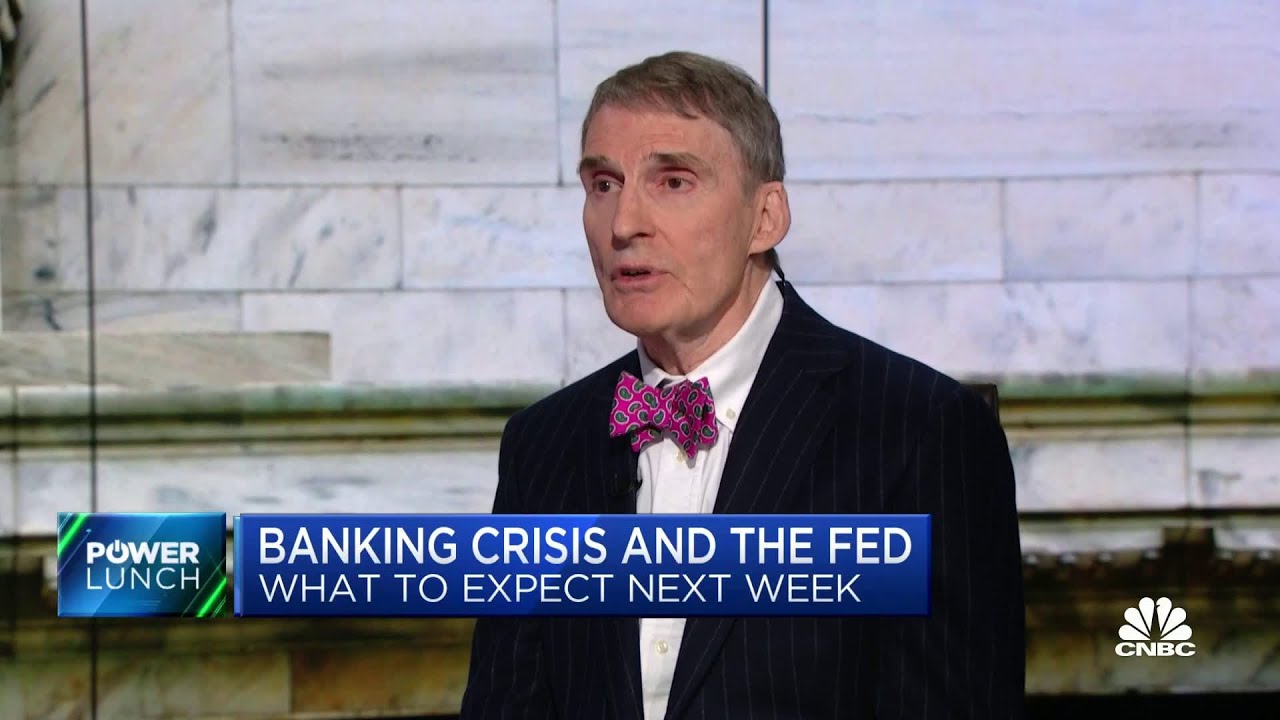

The Fed’s Dilemma: Managing a Banking Crisis While Battling Inflation – Insights from Jim Grant
In recent months, the financial world has been grappling with a growing concern: the Federal Reserve’s capacity to effectively manage a banking crisis while simultaneously combating inflation. Renowned financial journalist Jim Grant of Grant’s Interest Rate Observer has shed light on this conundrum, highlighting the complexities at play and the potential ramifications for the economy.
The Dual Mandate of the Federal Reserve
At the heart of the Federal Reserve’s operations is its dual mandate: to promote maximum employment and stable prices. This balancing act becomes particularly challenging in times of economic turbulence. As inflation continues to rise, the Fed has been compelled to raise interest rates in an effort to curb price growth. However, this tightening of monetary policy can have unintended consequences, particularly for the banking sector.
Recent Developments in the Banking Sector
The banking sector has faced significant stress, a situation exacerbated by rising interest rates. Grants warns that higher borrowing costs can lead to increased defaults and liquidity challenges for banks, potentially sparking a wider banking crisis. This is particularly concerning when considering the effects of past bank failures, notably during the 2008 financial crisis, which left a profound impact on the economy and consumer confidence.
Inflation: The Persistent Enemy
While the Fed attempts to stabilize the banking sector, inflation remains a relentless adversary. Factors such as supply chain disruptions, rising energy prices, and geopolitical uncertainties have driven inflationary pressures to levels not seen in decades. In such an environment, the Fed’s rate hikes, aimed at cooling demand, risk further unsettling an already fragile banking landscape and the broader economy.
A Balancing Act with Limited Tools
Jim Grant argues that the tools available to the Fed may not be sufficient to effectively address both the banking crisis and inflation. Conventional monetary policy, such as interest rate adjustments and quantitative tightening, may lead to adverse side effects, including further stress on the banking system and potential financial instability.
Grant’s perspective illustrates a crucial point: the financial system operates on delicate assumptions about stability and trust. A rise in interest rates can undermine those assumptions, leading to a tightening of credit conditions that further complicate the Fed’s objectives.
The Road Ahead
As the Fed navigates this intricate landscape, it must consider the implications of its actions. A hasty approach to raising rates could precipitate a banking crisis that ultimately worsens inflationary pressures, while inaction could allow inflation to remain entrenched, eroding purchasing power and economic momentum.
Moreover, Grant underscores the importance of transparency and communication. The Fed’s forward guidance must be clear and credible to instill confidence in financial markets, thereby reducing panic and speculation during turbulent times.
Conclusion
The current economic environment poses a formidable challenge for the Federal Reserve. As Jim Grant of Grant’s Interest Rate Observer aptly points out, the delicate interplay between managing a banking crisis and fighting inflation is fraught with risk. Policymakers must tread carefully, ensuring that their strategies not only aim to curb price growth but also support stability in the banking sector. As the economic landscape continues to evolve, the Fed’s ability to adapt to these dual challenges will be a critical determinant of the nation’s financial health in the coming years.
LEARN ABOUT: Investing During Inflation
REVEALED: Best Investment During Inflation
HOW TO INVEST IN GOLD: Gold IRA Investing
HOW TO INVEST IN SILVER: Silver IRA Investing




I think in response to the title this missive is directed at China not the USA meaning Xi China is responding to an economic and financial calamity no different from how Erdogon Turkey has done: hammer interest rates to the lowest possible. The US Federal Reserve is raising interest rates precisely because the "thinking" quite correct as events have played out there be a stunning amount of inflation deemed as "acceptable" as the response to Life after Lockdowns. The USA has been quite alone in this approach as well … something quite unique in a post Plaza Accords World and what was known "back in the day" as the Malign Neglect of the US Dollar. Not so 2022-2023. Long $ual United Airlines strong buy
Central banks(ers) are total fools; yes I understand they've undoubtedly done extremely well out of lending so much cheap money for so long personally, BUT they've done it with no foresight. Now, here we are: a debt ridden society, culture & 2 triggers occurred; a relatively mild pandemic where a few million ppl perished (a drop in the ocean of 8+ billion), & the start of a biggish war; Russia invaded Ukraine.
The fact is it was utterly stupid, akin to bad parenting, to keep lowering rates AND lend out money hand over fist to ninjas (No Income, No Job) for so long before, so long ever.
Strippers in florida had 3, 4, 5 properties! It was totally irresponsible.
And still is.
In 2008/09 the bubbling volcano of credit and debt spewed a little. That's all.
Since then it has just gotten hotter and hotter, bubbling all the more.
The dow is 55% rich.
U.S. credit card debt has surpassed 1 TRILLION DOLLARS for the 1st time in history.
Student loans are & have been for at least 2 decades, out of control. Literally.
Auto debt.
Very little savings.
Endless, ridiculous programmes of QE – Thanks benanke, well done, moron… an economy can't survive by simply just printing more money.
The lack of responsibility and regulation is beginning to bite. The ratings agencies should damn well be disbanded frankly. They are literally pointless.
Things are about to get very bad. 2024, march….
Rate rise to combat inflation. Lies lies and more lies. They are still spending the money. It's just getting re directed to the greedy bansters
Jim Grant for Fed Chair.
More immigration will allow commercial real estate to be trasnformed into condos. We have the jobs for more people, and this strategy will make more jobs.
The failure of Silicon Valley Bank has torn into global markets, with investors ripping up their forecasts for further rises in interest rates and dumping bank stocks around the world. I'm at a crossroads deciding if to liquidate my dipping 200k stocck portfolio, what’s the best way to take advantage of this bear market?
Silicon Valley Bank (SVB) was the 16th largest bank in the US, and it wasn't subject to the most strict controls. How many banks actually are subject to those controls, besides the big four? Any bank could suffer a run and fail, and if that happens to a community level or even state level bank it probably won't upset the national economy or ecosystem of banks, but any multi-state bank should be more closely watched.
With inflation running at a four-decade high, a Recession is now the ‘most likely outcome for the economy. How can I grow my portfolio to outpace inflation and maintain a successful long-term strategy? I have been reading of investors making about $250k profit in this current crashing market, and I need ideas on how to achieve similar profits.
At last the federal reserve bank is done, goodbye leech gods taking them out soooo happy
The problem is , the feds can't fight inflation when Biden is wrecklessly spending …its an oxymoron.
bill nuy, finance guy!
My boy Bill Nye the science Guy tell us what to do
I blame the FEDs for this, because in the end they benefit by either buying off the failed banks cheaper or something. The fed can print credit as long as someone will borrow it into existence, but they cannot print product (or production).
The fed is composed of a pack of financial mutants, goofballs and bunglers who do more than anyone or anything else in the USA to f____ up this country's economy and financial system!!!!!! Get rid of them!!!!!!!!!
Jerome Powell and Janet Yellen are lost in a fog bank in a runaway Ford Pinto? My thoughts exactly!
As a foreigner who lived through the entire duration of zero covid for the past 3 years in China, this is by far the most objective commentary I’ve seen on YouTube to date. Economists and business leaders are voicing concerns at the start of 2023 that the year could be a difficult one. JPMorgan Chase & Co. Chief Executive Jamie Dimon said Tuesday that the Federal Reserve may need to raise interest rates to 6% to fight inflation, higher than the peak level between 5% and 5.5% in 2023 that most Fed officials penciled in after their December meeting. Although I read an article of people that grossed profits up to $500k during this crash, what are the best stocks to buy now or put on a watchlist
Banks are fine, FUD and people doing run on banks are the issue. Wasn't too long ago a holes were running out to buy car loads of toilet paper, dont be that a hole.
It was a very bad decision to remove the Glass-Steagall Act in the late 1990s, which led to the spectacular failure of huge banks during the financial crisis of 2007–2008. To prevent another disaster, Dodd-Frank and this statute both need to be reestablished right away. What happened with SVB is only the beginning of what will happen if nothing is done to address the current situation.
The stock market has been a really tough one this past year, but I watched an interview on CNBC where the anchor kept mentioning "KATRINA VANRENSUM ". This prompted me to get in touch with her, and from August 2022 till now we have been working together, and I can now boast of $540,000 in my trading portfolio.