
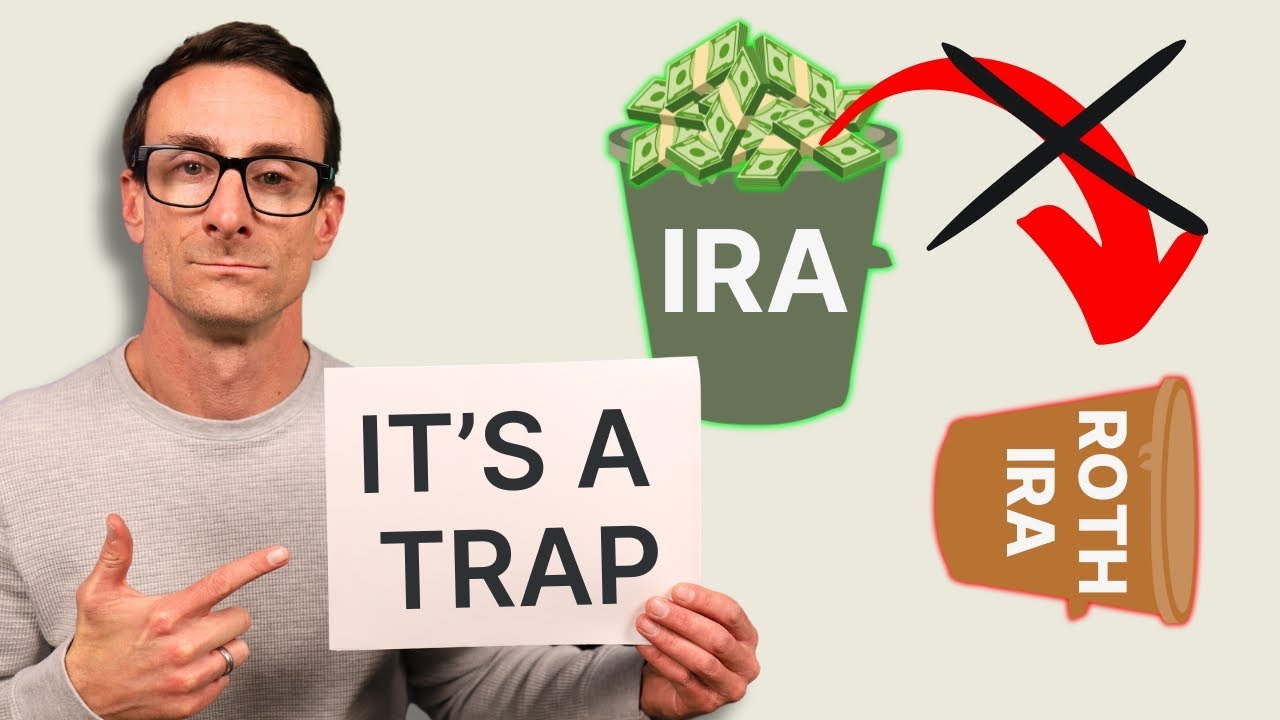
5 Real Reasons to Think Twice About a Roth Conversion
1. Medicare IRMAA surcharges
A Roth conversion adds directly to your modified adjusted gross income, and Medicare sets your Part B and Part D premium tier based on your MAGI from two years earlier. A married couple with a MAGI around $230,000 who completes a $100,000 conversion can move from IRMAA Tier 1 to Tier 3 – an increase of roughly $200 per month, per spouse, or close to $5,000 for the year in extra Medicare premiums alone. This cost is easy to miss because it shows up two years later, not in the tax return for the conversion year itself.
2. The tax bill is due now, in cash
The entire converted amount is taxed as ordinary income in the year of conversion – there’s no spreading it out unless you convert smaller amounts across multiple years on purpose. If you don’t have cash on hand outside the IRA to cover that tax bill, the conversion gets financially painful fast.
3. Each conversion has its own 5-year clock
Converted funds need to sit for 5 years, starting January 1 of the conversion year, before their earnings can be withdrawn penalty-free if you’re under 59 1/2. Convert in three different years and you have three separate 5-year clocks running – a detail that trips up retirees who assume one conversion “unlocks” penalty-free access to everything in the account.
4. More of your Social Security can become taxable
Higher MAGI from a conversion can also push a larger share of your Social Security benefits into taxable territory, since that taxability is calculated using a formula based on your combined income. This compounds with the IRMAA effect above, since both are driven by the same underlying income spike in the conversion year.
5. Paying the tax from the IRA itself shrinks the benefit
If you have the custodian withhold tax directly from the converted amount rather than paying it from outside savings, less money actually reaches Roth status to grow tax-free – and if you’re under 59 1/2, the withheld portion can be hit with a 10% early-withdrawal penalty on top of the tax, since it never completes the rollover into the Roth account.
None of this means “never convert”
These are reasons to model the full picture – taxes, IRMAA, and Social Security taxability together – before converting, not reasons to rule it out automatically. A conversion done in a genuinely low-income year, paid for with outside cash, can still make sense even after weighing all five factors above.
Curious about the newer 2025 tax-law backdrop for this decision? How the 2025 Tax Law Changed Roth Conversion Planning →
Frequently Asked Questions
Does a Roth conversion count as income for Medicare’s IRMAA surcharge?
Yes – it adds to your MAGI, and Medicare uses your MAGI from two years earlier to set your premium tier, which can add thousands per year.
Does each Roth conversion have its own 5-year rule?
Yes – each conversion starts a separate 5-year clock on January 1 of the conversion year for penalty-free access to its earnings.
What’s the biggest mistake retirees make with Roth conversions?
Converting a large lump sum without checking the effect on Medicare IRMAA brackets and Social Security taxability, both driven by the same income spike.
Should I pay the conversion tax from the IRA itself or from other savings?
From outside savings if possible – paying from the IRA shrinks the amount that reaches Roth status and can trigger an early-withdrawal penalty if you’re under 59 1/2.
- Range, “IRMAA and Roth Conversions: The Ultimate Guide” – range.com/blog – the $100,000-conversion/Tier 1-to-Tier 3 IRMAA example.
- RetireHub, “Roth Conversion 5-Year Rule: What Retirees Must Know in 2026” – retirehub.org – per-conversion 5-year clock mechanics.
- Kiplinger, “How a Roth Conversion Can Save You Money in Medicare Costs” – kiplinger.com/retirement – background on the IRMAA/MAGI interaction and Social Security taxability.


So why on Earth did my stupid ass financial planner talk me into doing this? I need a fiduciary, not a salesman.
Most of the software used to calculate Roth conversion strategy makes the assumption that you live into your 80s. Something you need to think about.
My wife and I are retired with almost all of our money in traditional IRAs. We are on SS and Medicare, and the biggest impediment to doing any Roth conversions at this point is triggering IRMAA. We would need to use money from our IRAs to fund the taxes on the conversions, and that make no sense at this point. I wish we would have done some Roth conversions when we were still working and not on SS and Medicare, but we didn't. So, at this point Roth conversions are not a viable option for us, as we would never reach the breakeven point. I have modeled doing Roth conversions eights ways to Sunday, and they NEVER result in lower taxes until far beyond our expected lifetimes.
One expert says convert the next one says don't. Can't watch anymore. I'm just going to convert some every year that doesn't throw me into the next tax bracket.
No one mentions legacy …..a Roth and ensures that there's no tax to the estate proper conversion tactics Ensure that you do not bump up the tax bracket