
[ad_2]
Understanding Social Security Benefits: Calculating Benefits on a $50,000 Salary
Social Security is a crucial program in the United States that provides financial assistance to millions of retirees, disabled individuals, and survivors of deceased workers. Understanding how Social Security benefits are calculated is vital, especially if you’re planning your financial future. In this article, we will break down how benefits are calculated based on a $50,000 annual salary.
What is the Social Security Administration (SSA)?
The Social Security Administration (SSA) is the federal agency responsible for managing the Social Security program. It administers Old-Age, Survivors, and Disability Insurance (OASDI), among other programs. Your benefits from Social Security primarily depend on your earnings history and the age at which you decide to start claiming benefits.
How Benefits are Calculated
The amount of Social Security benefits you receive is based on your Average Indexed Monthly Earnings (AIME) and the Primary Insurance Amount (PIA). Here’s how the process works:
-
Calculating AIME:
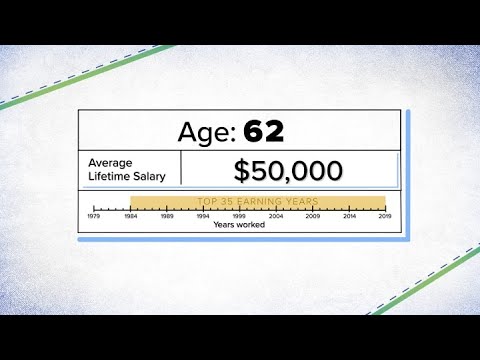
- To determine your AIME, the SSA looks at your highest-earning 35 years of work experience, adjusts those earnings for inflation, and then averages them.
- For someone earning $50,000 a year, this equation would involve indexing that salary for inflation over the years you’ve worked.
-
Understanding PIA:
- Once your AIME is established, the SSA calculates your Primary Insurance Amount (PIA). This figure determines how much you will receive each month if you retire at your full retirement age.
- The SSA uses a formula to convert AIME into PIA. As of 2023, the formula is structured to favor lower-income earners, providing them with a higher replacement rate. This formula has "bend points" which change annually.
-
Applying the Formula:
-
For example, let’s assume you have a consistent salary of $50,000 over 35 years without any inflation adjustment. To illustrate, we’ll use 2023 bend points which are roughly $1,115 (first bend point) and $6,721 (second bend point):
- 90% of the first $1,115
- 32% of the amount between $1,115 and $6,721
- 15% of any amount over $6,721
-
Firstly, assign your monthly earnings:
[
AIME = frac{50,000 text{ annual salary}}{12 text{ months}} = $4,166.67
] -
Next, apply it to the formula:
- The first portion (up to $1,115):
[
90% times 1,115 = 1,003.50
] - The next portion (from $1,115 to your AIME, which is $4,166.67):
[
32% times (4,166.67 – 1,115) = 32% times 3,051.67 approx 976.53
]
- The first portion (up to $1,115):
- Summing these amounts gives:
[
PIA = 1,003.50 + 976.53 approx 1,980.03
]
-
Thus, if you retire at your full retirement age, your estimated monthly Social Security benefit would be approximately $1,980.
Early or Delayed Retirement
It’s important to note that you have the option to start receiving Social Security benefits as early as age 62 or delay them until age 70. However, the amount you receive will be reduced if you take your benefits early or increased if you delay:
- Early Retirement: If you choose to start benefits at 62, your benefits could be reduced by up to 30%.
- Delayed Retirement: If you wait until age 70, your benefits could increase by up to 8% per year.
Factors Influencing Your Benefits
- Longevity: The longer you live, the more you benefit from delaying Social Security.
- Other Income: If you have other retirement savings or pensions, you might not rely as heavily on Social Security.
- Changes in Earnings: If you earn more than the threshold while working after you begin receiving benefits, your benefits may be temporarily reduced.
Conclusion
In summary, for someone earning $50,000 annually, understanding Social Security benefit calculations can help maximize your retirement income. Planning your retirement by considering the age at which you start receiving benefits can have significant implications on your overall financial stability. If you’re looking for advice tailored to your situation, consulting with a financial planner can be a wise decision. Remember, Social Security is one piece of the puzzle; ensuring you have a comprehensive retirement plan is crucial for a secure and comfortable future.
LEARN MORE ABOUT: Retirement Pension Plans
REVEALED: Best Investment During Inflation
HOW TO INVEST IN GOLD: Gold IRA Investing
HOW TO INVEST IN SILVER: Silver IRA Investing


0 Comments