
[ad_2]
This Magic Number Predicts 95% Accuracy For Retirement Success (But There’s a Catch)
For years, countless experts have debated the “magic number” for retirement savings. Should you aim for a million? Two million? More? While a specific dollar amount can be helpful, it often falls short of capturing the nuances of individual circumstances.
Enter a potentially more powerful and surprisingly accurate predictor: the “Savings Rate.”
Recent studies, and the accumulated wisdom of financial advisors, suggest that your savings rate – the percentage of your income you consistently sock away each year – is a remarkably strong indicator of retirement success. In fact, some models claim a staggering 95% accuracy in predicting a comfortable retirement when focusing on this metric.
So, what’s the magic savings rate?
While there’s no one-size-fits-all answer, the general consensus points to a savings rate of 15% or higher. This includes contributions to 401(k)s, IRAs, brokerage accounts, and even any employer matching funds.
Why is the savings rate so effective?
The savings rate offers several advantages over focusing solely on a dollar amount:
- Adaptability: It automatically adjusts to your income. A percentage-based goal scales with your earnings, meaning you’re consistently saving an appropriate amount, regardless of your salary fluctuations.
- Focus on Behavior: It encourages consistent saving habits. By focusing on the percentage, you’re building a lifelong commitment to saving, rather than chasing a static target.
- Flexibility: It allows for adjustments based on individual circumstances. While 15% is a good starting point, factors like your age, debt levels, desired lifestyle, and expected retirement age can influence the ideal savings rate.
The Catch: It’s Not the Only Number That Matters
While the savings rate is a powerful predictor, it’s crucial to understand its limitations. The 95% accuracy claim, while compelling, often comes with caveats:
- Time Horizon: The accuracy relies on consistent saving over a long period, ideally starting early in your career. Starting late significantly reduces the effectiveness of this metric.
- Investment Strategy: A high savings rate won’t guarantee success if your investments are poorly managed. Diversification and appropriate risk tolerance are essential.
- Spending Habits: Your pre-retirement spending habits are a strong indicator of your post-retirement needs. Overspending before retirement can negate the benefits of a high savings rate.
- Unexpected Expenses: Life throws curveballs. Unforeseen medical expenses, job loss, or other unexpected events can derail even the best-laid retirement plans.
- Inflation: The model needs to account for inflation. If your investments don’t outpace inflation, your savings might not be enough to maintain your desired lifestyle.
Putting the Magic Number to Work for You
Here’s how you can use the savings rate to improve your retirement prospects:
- Calculate Your Current Savings Rate: Determine how much you’re currently saving each year as a percentage of your gross income.
- Compare to the Benchmark: Is your savings rate above 15%? If not, identify ways to increase it, even incrementally.
- Adjust Based on Your Circumstances: Consider factors like age, debt, desired lifestyle, and retirement age. A financial advisor can help you determine the ideal savings rate for your specific situation.
- Develop a Comprehensive Financial Plan: Don’t rely solely on the savings rate. Create a broader plan that includes budgeting, debt management, investment strategy, and insurance coverage.
- Review and Adjust Regularly: Life changes, and your retirement plan should too. Regularly review your progress and make adjustments as needed.
In Conclusion:
The “savings rate” is a valuable and surprisingly accurate tool for predicting retirement success. While it’s not a magic bullet, aiming for a consistent savings rate of 15% or higher, combined with a comprehensive financial plan and diligent management, can significantly increase your chances of a comfortable and secure retirement. Remember to tailor your strategy to your individual needs and seek professional advice when necessary. The key is consistent saving, smart investing, and a realistic understanding of your retirement needs.
LEARN MORE ABOUT: Qualified Retirement Plans
REVEALED: How To Invest During Inflation
HOW TO INVEST IN GOLD: Gold IRA Investing
HOW TO INVEST IN SILVER: Silver IRA Investing


What risk levels did you use for 1st year spending, upper guardrail, and lower guardrail?
85, 99, and 25 percent?
Based on your initial statement, I would be curious to see an historic comparison between that and initial spending/guardrails of 50, 75, and 25 percent, or similar.
Why would you pull more out of the portfolio early to avoid taking SS, instead of taking SS as soon as you retire to allow the portfolio to grow more.
Clickbait: misleading title!
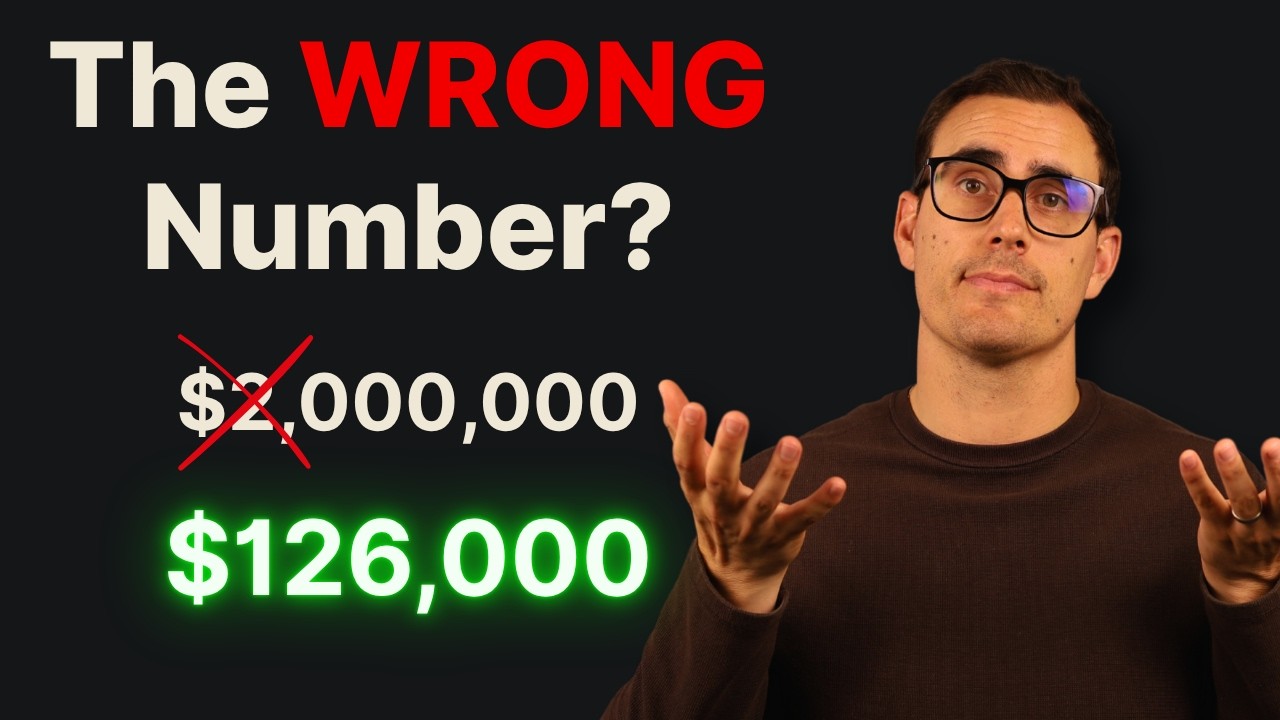
Thumbnail has $2 million crossed out… first example uses a $2 million portfolio.
Love your content! It’s not easy to get through these.
Just a small ask—could you slow down a bit and add some pauses? It would make it much easier to process, adds emphasis, and makes your message clearer. Even just a second or two between key points can make a big difference.
Buy robots and make them go out and earn money on the side and give it to you. Ta-da!
I don't understand the "how much can I spend each month?" way of thinking. Instead, it should be "how much can I avoid spending?" People are generally really stupid with money. I know I used to be in my younger years. For example, if I could withdraw $10,000 per month from retirement according to all these calculations, but I really only need of half that to live on, I am only going to take out half.
You need to have cash flow from a variety of sources, not just the stock and bond markets or social security.
That 'magic number' statistic gives false confidence. 95% accuracy? Only if you're a robot who won't face medical emergencies, market crashes, or divorce. Real retirement isn't a math equation.
Like this idea
This is the most useful video about this. Thank you.
Time horizon has a massive impact on the Monte Carlo. I’ve modeled a skilled nursing scenario with an age adjustment to average life expectancy and the spending limit actually increases as the impact of 10 fewer years of funding retirement has a greater impact than the long term care itself. As such, if a couple targets 90% Monte Carlo, they should experience a gradual increase in next year’s Monte Carlo score when all scenario assumptions are met.
I came up with a number representing how much I spend in a year then subtract out how much social security I'll get. The difference is how much I'll need to earn/withdraw from retirement accounts. My current paycheck doesn't matter at all because I save about 25% of my gross pay and I still have extra money each month.
Simple mode, I had a 6% chance based upon my liquid . Advanced mode, I had 100%.
I invested in rental property that has more income than I plan to spend.
Advanced mode has me at 0% withdrawal even without SS.
This is what I tell myself. If my home is paid for (no rent or mortgage), and I don’t have any debt, and I have health insurance of some kind, then I can probably live off about $1000/month. $1500 if I get spendy. That’s what I tell myself. Lol. I might be fooling myself too.
Let’s face it if you don’t have a trillion in savings you’ll never make it
Wait… why would you commit capital destruction by ever selling anything? This is insane. So when you’re most vulnerable (you’re really old and incapable of work to make income) you have the least amount of resources available… never sell and borrow against At a lower rate than your withdrawal rate letting the capital bar compound into the future.
Great video and valuable information! Appreciate it
I recommend to my students to be on the lookout for passions/hobbies you can monetize. A side gig that pays $500/week might end up being worth and extra 500K in your 401K.
And then the possible social security reduction
Money means ability, but isn’t everything it’s cracked up to be. Sure, we all need money to live and enjoy, but don’t forget to do what you love and have passion for. One day (if you’re lucky) you will look in to the mirror and see an old person smiling back at you, and you can grin knowing you lived a full life with love, compassion and vigor. Try and find small moments that matter to someone else – you will be glad you did.
When I think about retirement, I think about the math involved, and then I decide to continue working instead. This motivator is called Fear of Math (FoM). If I can no longer work, then deciding when to retire is no longer a problem. Hoping my wife and daughter throw a huge party when I kick the final field goal as they figure out when to yard sale all the crap I've left behind.
God bless the good people who have 2M … i am not one of them … I look forward to seeing a video that better applies to me …
You have such a wealth of information (no pun intended) to share ~ but please slow the talking speed down. I doubt you're on a time constraint to get the video done and for us beingers it's difficult to grasp everything you're teaching. Also, using more realistic and current average numbers would be more helpful.
Thanks for putting us on to Evelyn Elaina Nala in one of your videos. I started with just $3,500 a months ago and now I’ve crossed $9K. Nothing crazy—just steady flips and clear signals. Honestly, I was tired of watching other people win while I stayed stuck. This was the switch I needed.
Am I correct in concluding that the increased volatility of the "dynamic spending" and the "percentage of portfolio" rules/methods is less of a concern for those with a pension and/or some other additional source of consistent revenue (e.g. rental property income)?
The idea that the example retired portfolio would see 10% growth in the first year, says that this retired person/couple has most/all their money in stocks. A very very dangerous gamble. No one over sixty should have money in the stock market. They don’t have time to earn their money back if stocks drop by 25%, or 50%, or, like in the depression of 1929-32, drop 89%.
How do the upper and lower guardrails adjust in year 2+ as you are naturally spending down your portfolio?
There is nothing magical about the initial withdrawal rate, balance, expected return, and years in retirement that you plug into such projection tools to get the 'model' for how the next 30 years (for example) might play out. It is simply a 'best guess' done using the figures you have (or expect to have) for 'year 0'. I really don't see why this initial value is taken as some sort of permanent marker, and then only adjusted for inflation (the old '4% rule' spending adjustment), or adjusted slightly (the 'guardrails' 'vanguard' or 'kitces' etc methods). — These all take that initial calculated 'best guess' and then just tweak it slightly based on the prior year's actual performance being better or worse than 'planned'. This seems to all be based on the initial Monte Carlo simulation being something so complex that only a financial advisor could do it for you at the start of retirement. Might have been true years ago, but nowadays anyone can grab the numbers, plug them into a projection tool, and get the 'year 0' model results.
So, why not just redo the 'best guess' calculation each year and make your 'allowance' actual match the new reality each year, rather than try to revamp an initial estimate that gets less and less relevant each year as reality deviates from that initial 'projection'?
eg. 1st time: plug in portfolio asset allocation, starting value, duration (eg 30 yrs), and calculate the annual withdrawal rate that has a 90% (or 80% or whatever seems appropriate) chance of 'success'. Take this amount out for year 1 retirement spending.
Then, instead of simply 'adjusting' that initial figure based on the actual return in that first year being better or worse than 'expected', instead why not recalculate and get a new, better estimate based on the 'new reality' at the end of year 1? ie plug into the same calculator at the start of year 1:portfolio asset allocation, new 'starting value', new duration (eg now 29 yrs), and get a whole new 'withdrawal rate' calculated on the actual situation at the end of your 1st year of retirement, NOT taking the figure calculated last year and now no longer relevant (since some of the parameters have changed — mainly the portfolio value).
You can also then adjust the parameters used each year — eg. if you get an inheritance the 'lump sum' starting value might unexpectedly increase. or if you have a large, unplanned 'one off' expense, this too will be taken into account in the new 'projection', and if you have a major health issue you might decide to cut the remaining retirement duration (or increase it if you are still healthy and your parents lived longer than average) etc.
Monte Carlo Simulation should not give you 100% success rate.
It's a statistical analysis program, and 100% doesn't exist.
Actually, it's very simple. Annual asset growth X 80% for annual withdrawal.
All you need to maintain perpetual wealth until you hit the RMD.